


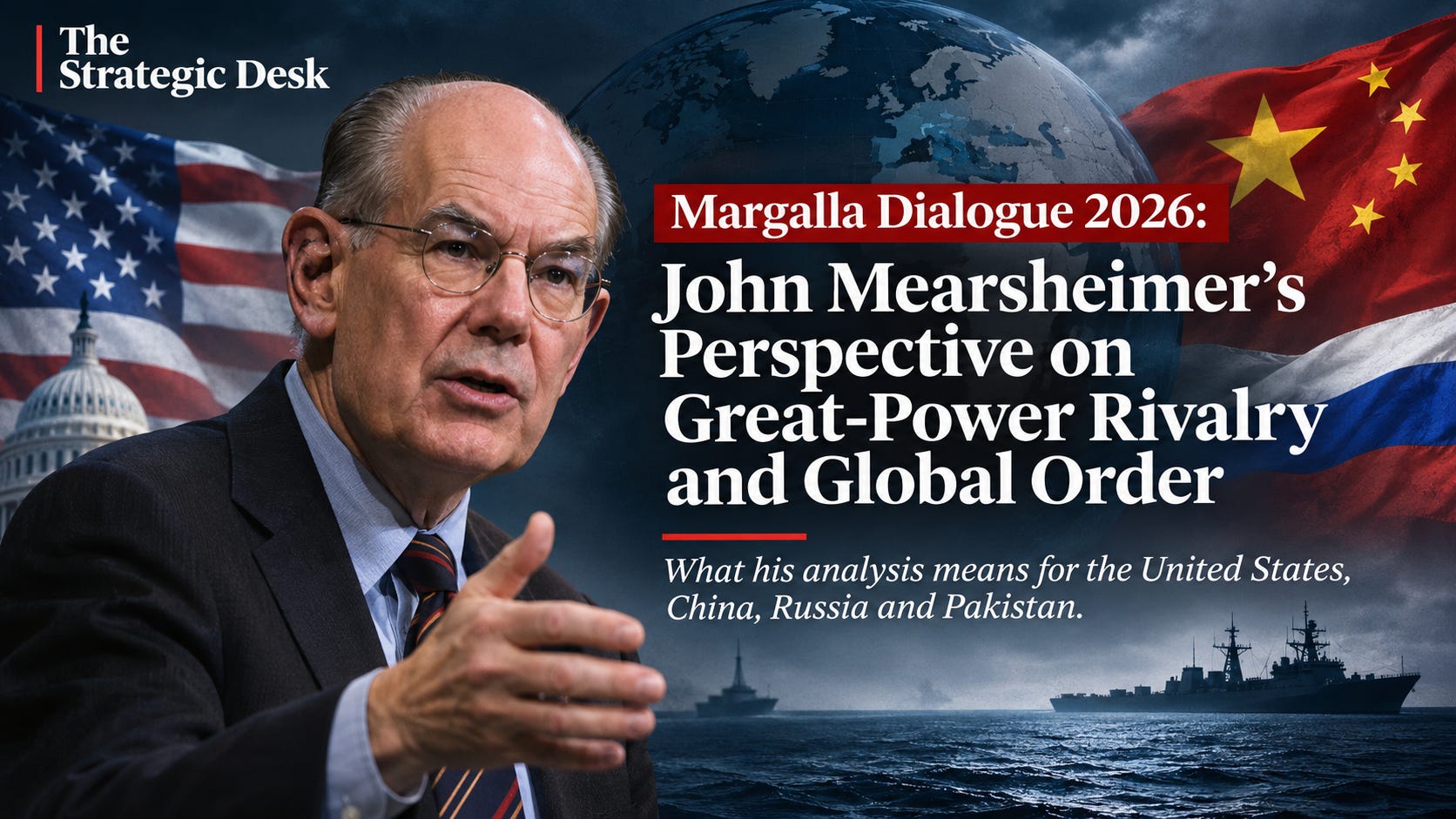
Under the theme “Global Order in Transition: Navigating Strategic Uncertainty,” the Margalla Dialogue 2026 was hosted by the Pakistan Institute of International Affairs (PIIA) with the distinguished presence of Professor John J. Mearsheimer, the Distinguished Service Professor of Political Science at the University of Chicago, USA. The session was moderated by Brigadier Dr Raashid Wali Janjua (Retd), Director of Research and Analysis at the Islamabad Policy Research Institute (IPRI). This article draws primarily on Mearsheimer’s keynote address, examining his arguments and analysis of the changing international order, great-power competition and the strategic rivalries shaping global politics. It explores his assessment of the shifting balance of power and the implications of these developments for regional and international security, particularly Pakistan’s strategic environment.
Assessing the rationality of US foreign policy, Mearsheimer questioned President Donald Trump’s decision to launch military operations against Iran on 28 February 2026. He said the strategy was based on the false premise that an all-out air strike, along with the removal of key leaders, would force Iran to meet American demands and bring about regime change. But, as Mearsheimer points out, history does not support the claim that air power can achieve regime change alone. He cited the Iraq invasion in 2003, in which the U.S. employed a ground invasion to remove Saddam Hussein. He also claimed that several senior American officials, including Vice President JD Vance, Secretary of State Marco Rubio, CIA Director John Ratcliffe, and Chairman of the Joint Chiefs of Staff General Dan Caine, had reservations about the proposed military strategy. He stated that the decision was “short on meaningful deliberation” and ignored strategic concerns of top advisors.
Meanwhile, Mearsheimer also contended that Washington had not accomplished its four declared goals in the Iran war: the removal of Iran’s nuclear weapons, the disruption of its ballistic missile program, cutting ties with Hamas, Hezbollah and the Houthis, and regime change. He argued instead that the war had made Iran more powerful than ever, especially with its ownership of the Strait of Hormuz, the destruction of U.S. military bases in the Persian Gulf, and the destabilization of the region’s security. He warned that further military escalation would worsen the situation rather than resolve it.
In his discussion of Israel’s military operation in Gaza, Mearsheimer offered a strongly critical evaluation of the Israeli policy since the 7 October 2023 attacks. He claimed that Israel has exploited the situation to eject Palestinians from Gaza and implement its plans for a Greater Israel that includes the West Bank and Gaza. He said the military campaign had not displaced Palestinians in Gaza, despite the widespread destruction and civilian deaths. He also blamed Washington, stating that its military and diplomatic aid had allowed Israel to remain in operations. These were Mearsheimer’s political and legal descriptions of the conflict, not conclusions that were drawn by the address itself.
Regarding the changing international order, Mearsheimer claimed that the world had moved beyond the “unipolar moment,” which had been dominated by the United States after the collapse of the Soviet Union in 1991. He identified 2017 as the approximate turning point towards a multipolar system comprising three major powers: the United States, China and Russia. He said that Russia was the weakest of the three, but that it still had great-power status. He has stressed that the distribution of power is fundamental to comprehend international politics. Also, the character of international competition is shaped by whether the international system is unipolar, bipolar or multipolar.
He described the United States-China rivalry as the great power rivalry of this century. According to him, China’s growing economic and military capabilities have shifted Washington’s strategic priorities towards East Asia, making the region more significant to American security interests than Europe. He called China Washington’s “main strategic competitor” and said the American pivot to Asia was basically an “evolution toward containment of the spread of Chinese influence. He also highlighted China’s ambition to develop a blue-water navy capable of projecting power beyond East Asia, through the Strait of Malacca and the Indian Ocean towards the Persian Gulf. He highlighted Taiwan, the South China Sea, the East China Sea and the China-India border area in the Himalayas as flashpoints.
In regard to Russia and the Ukraine conflict, Mearsheimer criticized the idea that Russia was a nation that could conquer Ukraine and then threaten the entire continent of Europe. He said that Russia’s military challenges in Ukraine showed “the shortcomings of a conventional military.” He also attacked Washington’s strategy on Moscow, saying the Ukraine conflict had brought the Russian Federation closer to China. A realist would say that it was contrary to America’s strategic interests, since Washington should want to stop the two other great powers from uniting against America. As he put it, “We don’t want the Russians to be allies with the Chinese.” He also said the conflict was undermining NATO unity and relations between the United States and Europe.
In the context of Pakistan’s strategic environment, Mearsheimer pointed out two constants. He said that Pakistan and India were perpetual rivals in the region, as historical conflicts and ongoing security tensions meant they would continue to be rivals for the foreseeable future. Second, he expressed surprise at Pakistan’s ability to maintain relatively good relations with both Washington and Beijing despite their growing strategic competition. He noted that Pakistan had not yet been forced to decide between the two powers, which he said was beneficial for Islamabad.
But he warned that keeping this balance would be more challenging with America’s growing rivalry with China and Washington’s deepening strategic ties with New Delhi. He said the United States would benefit from reducing the China-Pakistan strategic relationship, while also trying to have “good relations” with Pakistan. This will complicate the strategic balancing act for Islamabad, especially given the current naval modernization efforts by China and its desire for increased presence in the Indian Ocean and Persian Gulf. He also noted that India’s geographic location makes it strategic for Washington in the context of the Himalayan border issue and the Indian Ocean, but not a replacement for Washington’s allies in the East Asian region.
One of the most important observations was the impact of American military overstretch. Washington’s simultaneous commitments to the Persian Gulf and Ukraine reduced its ability to focus on East Asian military deployments, Mearsheimer said. He used the term “pivoting away from Asia” when discussing the redeployment of American naval and missile-defence forces. He said that the short-term strategic diversion had allowed Pakistan to intervene. However, he cautioned that this opportunity might narrow as Washington gradually redirects its attention towards East Asia and intensifies its competition with Beijing.
In the case of middle powers and international institutions, Mearsheimer recognized that Japan, India, Germany, and Pakistan are important, but their role is limited by the military and economic power of the great powers. He insisted that international institutions and international legal orders do not exist outside the distribution of powers on an international level. As he put it, “Great powers make the laws and make the institutions. He stated that institutions like the United Nations Security Council represent the interests of powerful nations, especially because of the veto power, and are incapable of enforcing compliance among major powers when their interests are at stake.
Responding to questions about China’s rise, he also rejected the assumption that Beijing’s preference for economic development and technological advancement necessarily makes it a peaceful power. While noting that China had not fought a war since 1979 and was investing in advanced technologies such as artificial intelligence and quantum computing. He also warned that its growing capabilities could produce more assertive behaviour in its neighbourhood. He also refused to accept the idea that America was about to pull back from the world and repeatedly characterized American foreign policy as “interventionist.”
Mearsheimer’s speech was a decidedly realist assessment of the current dynamics of international politics. His main thesis is that, despite the growing influence of international institutions, economic interdependence, and new middle-power partnerships. The distribution of power, military power, and national interests remains important determinants of state behaviour. His observations further underscored the need for Pakistan to maintain strategic flexibility amidst growing competition between Washington and Beijing.
Source: (IPRI and Islamabad Policy Research Institute 2026,
An important dimension of great-power rivalry is often overlooked: the strategic autonomy of states situated within competing geopolitical environments.
The competition between the United States and China is not simply about influence over regional actors; it is also about how countries such as Pakistan and Afghanistan preserve their freedom of action, national interests and long-term strategic options.
Geographical importance does not automatically translate into strategic advantage. Without institutional strength, economic resilience and informed political judgment, even strategically positioned states can become increasingly dependent on external powers.
Afghanistan's experience offers an important lesson: external influence and military superiority cannot, by themselves, produce sustainable security or a durable political order.
The deeper strategic question is therefore not which great power gains greater influence, but whether regional states can develop the internal capacity to shape their own future rather than remain instruments of competing external interests.
Great-power rivalry determines the pressures of the international environment; strategic autonomy determines how regional states respond to them.
— Wahidullah Noorzai | NIDA