


By Hayat Nazia
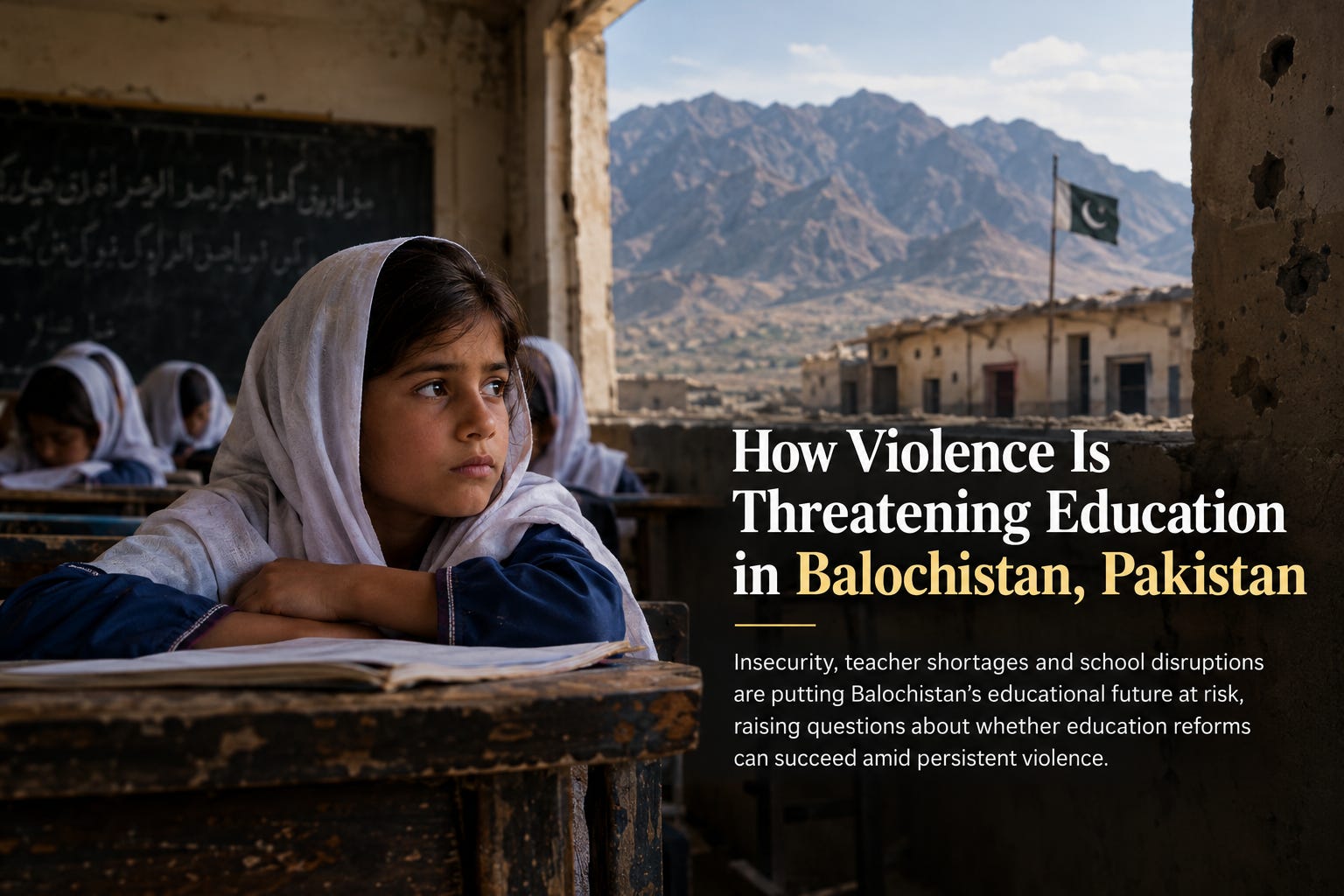
A school does not have to be destroyed for education to be disrupted.
A teacher leaving because of threats can create a vacancy that is difficult to fill. Security incidents can interrupt classes and keep children away from school. Repeated disruptions can reduce learning time and make it harder for an already fragile education system to maintain continuity.
Recent violence in Balochistan has again highlighted how insecurity can affect public education beyond the immediate loss of life.
In November 2024, a blast in Mastung killed seven people, including five schoolchildren, and injured 23 others, according to initial reports. The apparent target was a police vehicle escorting polio workers rather than the school itself, but the explosion occurred near children travelling to school.
In May 2025, a bombing targeting a school bus in Khuzdar killed 10 people, including eight students.
These incidents matter not only because of the lives lost. They raise a wider question: what happens to an education system when insecurity makes teachers, students and families uncertain about whether schools are safe?
When Teachers Leave, the System Loses Capacity
Human Rights Watch’s investigation, published in 2010, provides a clear example of how insecurity can weaken education without destroying a classroom.
Between January 2008 and October 2010, Human Rights Watch identified at least 22 teachers and other education personnel killed in Balochistan. Government figures cited by Human Rights Watch recorded 176 education personnel transferred within the province and another 44 transferred outside it between January 2008 and April 2010. Nearly 200 additional transfer requests were also being processed.
The consequences were not simply administrative.
Schools in affected areas became harder to staff. Human Rights Watch found that qualified replacements were difficult to recruit and that some rural schools remained understaffed. Some teachers who stayed also reported that fear and security concerns affected their attendance and ability to teach.
This creates a clear chain of disruption:
Insecurity → teacher transfers or absence → staffing shortages → difficulty replacing teachers → weaker educational continuity.
The damage caused by violence is therefore not limited to physical destruction. It can also weaken the people and institutions needed to keep schools functioning.
Lost School Days Reduce Learning Time
Security concerns can also reduce the amount of time students spend learning.
Human Rights Watch reported that a senior provincial government official estimated that government schools in Balochistan were open for 120 working days in 2009, compared with approximately 220 days elsewhere in Pakistan. This was a province-level estimate at the time, not a count for every individual school. Human Rights Watch also documented school closures and extended holidays linked to threats and violence.
A few missed school days may have limited effects. Repeated interruptions can have broader consequences for learning continuity.
When teaching time is repeatedly lost, students have fewer opportunities to complete lessons, practise skills and maintain continuity in their education.
The longer-term effect should therefore be understood as a risk rather than an automatic outcome. Persistent disruption can make it harder for an already weak education system to improve learning and keep children in school.
Violence Did Not Create All of Balochistan’s Education Problems
It is important, however, not to attribute all of Balochistan’s educational problems to violence.
The province already faced serious educational weaknesses, including low enrolment, poor infrastructure, gender disparities and limited institutional capacity. Human Rights Watch’s 2010 research documented very low educational participation in Balochistan, alongside significant shortages in basic school facilities.
In other words, violence did not create all of the province’s educational weaknesses. Insecurity can instead make those weaknesses harder to overcome.
This distinction matters for policy. A school system that is already struggling to recruit teachers, provide facilities and retain students has less capacity to absorb another shock. When insecurity forces teachers to leave or schools to close, existing problems can become even more difficult to address.
What Could Happen Next?
If insecurity remains high, the main risk is not necessarily the immediate closure of every school. A more gradual problem could emerge.
Qualified teachers may continue to avoid high-risk areas. Schools may struggle to maintain adequate staffing. Repeated interruptions could reduce the amount of teaching students receive and make it harder to improve enrolment, retention and learning.
These risks matter because education reform requires continuity.
A programme can build classrooms, train teachers or bring children back into school, but those gains are difficult to sustain if insecurity repeatedly disrupts the system.
There are, however, signs that targeted education programmes can improve access even in difficult conditions.
In June 2026, UNICEF reported that the five-year Balochistan Education Support Programme II had enabled more than 760,000 children to access quality education. More than 20,000 primary-level and over 2,200 middle-level out-of-school children were brought back into education through accelerated learning programmes, while 1,230 schools were improved.
The next challenge is to protect and sustain these gains.
Education Policy Needs a Security Lens
That requires looking at education and security together.
Authorities need to track teacher vacancies and retention, actual school days delivered, student attendance and retention, gender differences in access, and learning outcomes.
Security incidents should also be assessed for their effects on education rather than counted only as separate law-and-order events.
Such monitoring could help identify whether insecurity is weakening educational services even when schools remain formally open.
Balochistan’s education crisis is therefore not only about how many schools exist. It is also about whether teachers can safely remain in classrooms, whether students can attend consistently and whether educational institutions can continue functioning during periods of insecurity.
Protecting Balochistan’s educational future will require not only investment in schools, but also the conditions that allow those investments to produce lasting results.
The strategic question is not simply whether Balochistan can expand education.
It is whether those gains can survive the security environment.