

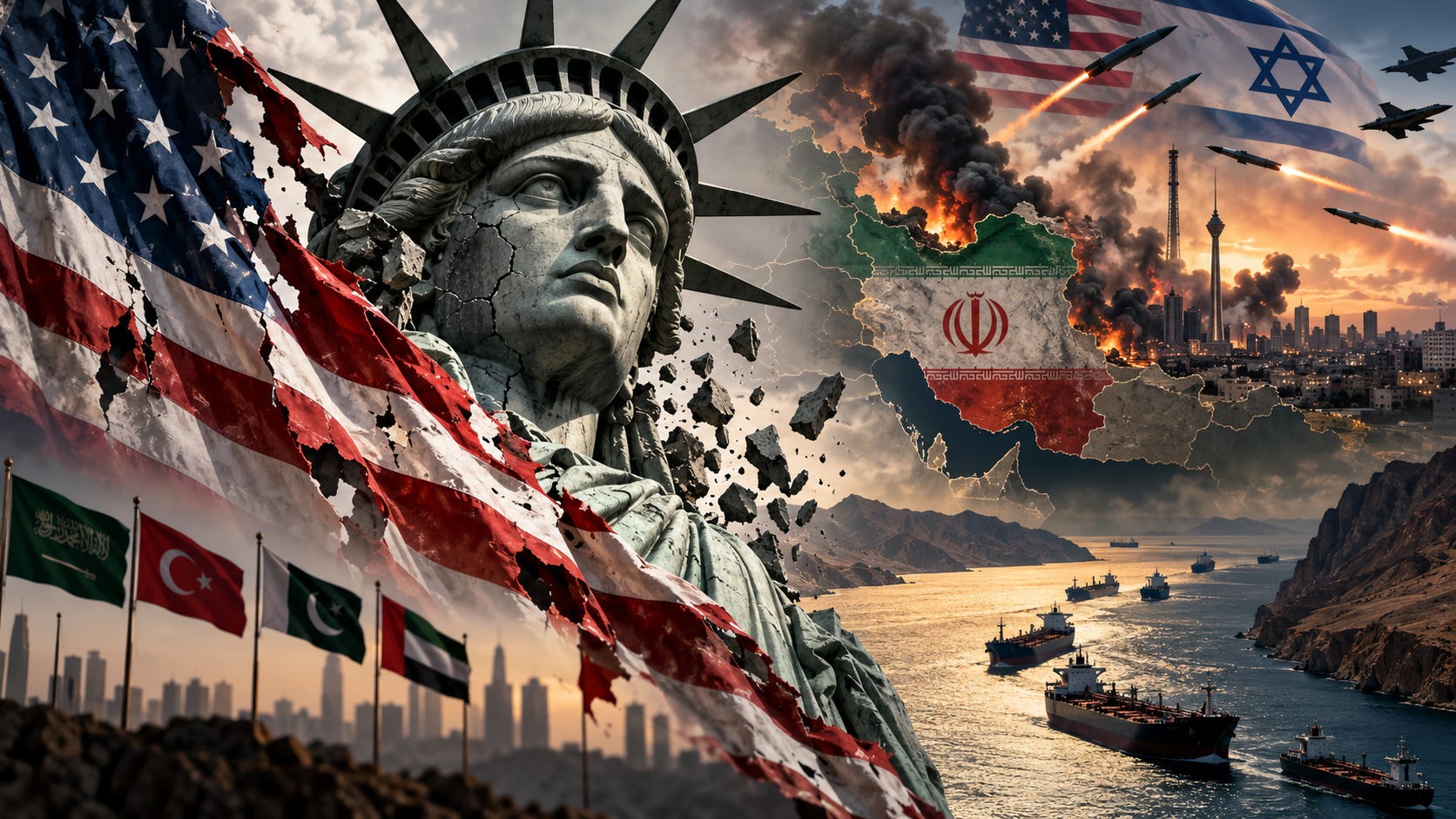
Hegemony cannot be defeated in a single battle. They bleed out slowly through wars they choose, allies they lose, and rules they break. For nearly eight decades, the United States has been the principal architect and guarantor of the international order. The winds are changing, though. The hegemonic powers do not simply fall off the face of the earth, or vanish in a single decisive battle. Whether Roman, Ottoman, British, or Russian, they are gradually weakened by a series of events that expose their growing limitations and accelerate changes already underway. The February 2026 US-Israeli war on Iran may well be remembered as one such event that created the cracks in Pax Americana.
Immediate effects of the war were devastating. On February 28, 2026, the United States and Israel waged a military assault against Tehran and other Iranian cities. The strikes were responsible for the death of Supreme Leader Ayatollah Ali Khamenei and several high-ranking members of the clerical regime. President Trump declared that the aim was regime change in Tehran and to change the strategic outlook for the entire Middle East.
However, the results were not what they were expecting. In response, Iranian forces launched missiles and armed drones against Israel and US military facilities in all six Gulf Cooperation Council countries. Iran also targeted civilian sites in the Gulf such as ports and airports. The hostilities effectively forced the closure of the strategic Strait of Hormuz, through which no less than 38% of the world’s crude oil supply passes.
The first rupture is strategic. The 1991 Gulf War and 2003 Iraq War represented the high watermark of American power. With the Soviet Union collapsing, Washington assembled an unprecedented UN-backed international coalition under the banner of a “New World Order”to expel Iraq from Kuwait. The Gulf monarchies had welcomed permanent American military presence, seeing the United States as the guarantor of security in the region. After the liberation of Kuwait, the United States signed long-term military contracts with several nations in the Gulf to open permanent and semi-permanent bases, including Al Udeid Air Base in Qatar, the Fifth Fleet headquarters of the United States Navy in Bahrain, Al Dhafra Air Base in the United Arab Emirates and Prince Sultan Air Base in Saudi Arabia.
These centres were highly effective but not entirely perfect over the last 30 years as a deterrent. But the Iran war inverted this logic. At the time of Iraq’s invasion of Kuwait in 1990, “the idea among Gulf countries was that the U.S. would provide security in the region,” says Allison Minor, director of the National Security Council. In 2026, the US and Israel struck first, while the Gulf States are left to deal with Iran’s retaliatory strikes. The war proved that hosting US forces is more harmful than protective.
This leads to a fast, wide-spreading diversification of security relationships. Riyadh is leading a wider regional security network, making more states take responsibility for maritime security than just one external power. As a result, Saudi Arabia, Türkiye, and Pakistan signed the Mecca Joint Defense Agreement in August. The accord appeared to be the cornerstone of a new regional security architecture aimed at preventing the emergence of a hegemonic regional power while also putting in place the foundations of a new order to replace Pax Americana. The U.S. had already shifted its approach in the region before the Iran war. In the words of a 2024 statement from US Central Command, it was “slowly transitioning from security guarantor to security integrator. America can give them weapons, training, intelligence, but not troops for regional wars.
The second rupture is moral. The US-Israeli attacks on Iran cannot be legally justified under any theory of the laws of war. The UN Charter, Article 2(4), forbids all UN members from threatening or using force against the territory or independence of another state. The Charter grants the Security Council the right to authorise the use of force against a member state in case that member state has violated international peace. The only exception is Article 51, which says that use of force is allowed to protect oneself against an armed attack. Iran has never attacked the United States and has never threatened to attack the United States unless they were attacked first.
President Trump has willfully violated US law. If there is no credible threat to the United States, the president does not have the legal right to launch an action that would result in the use of force without the approval of Congress. Trump attempted to argue that Iran was pursuing missiles capable of striking the United States, but Tehran has no such capability. Although US media coverage has for years focused on the Iranian nuclear program, Tehran has never developed nuclear weapons. In February 2026, polling showed that only 21 percent of Americans supported strikes on Iran, while 49 percent saw them as unnecessary and expensive.
The third rupture is economic. Iran attacked the Strait of Hormuz, affecting shipping and increasing the price of energy. Tehran demonstrated the power of a middle power to harm the global system. The economic impact was growing “unbearable”, not only for oil, but also for fertiliser, helium and supply lines, Qatar said. The US response, a “crushing economic operation,” failed to force submission. All six Gulf Cooperation Council countries were hit by Iran’s retaliation, including airports, ports, and hotels in Bahrain and the UAE. This was a departure from the 12-Day War scenario that Gulf Cooperation Council planners had long dreaded, which occurred in June 2025. Dragged into a war many see as US aggression; Gulf states now bear the brunt of Iran’s response. America’s political trajectory is eroding trust among its allies and partners.
Former Iranian diplomat Mehrdad Khonsari stated that “There is no question that Pax Americana, in light of new circumstances, needs to be redefined,” even as the United States continues to enjoy “exceptional hegemony in today’s multipolar world.” American power has not disappeared, but the three-war arc has created more room for regional powers to hedge against it.
🌍 THE WORLD ORDER IS CHANGING
Is Pax Americana beginning to crack? And what comes next for the global balance of power?
Subscribe to The Strategic Desk for independent analysis of geopolitics, conflicts, economics and the shifting alliances reshaping our world.
Don’t just read about the changing world. Understand where it is heading.
→ Subscribe to The Strategic Desk