


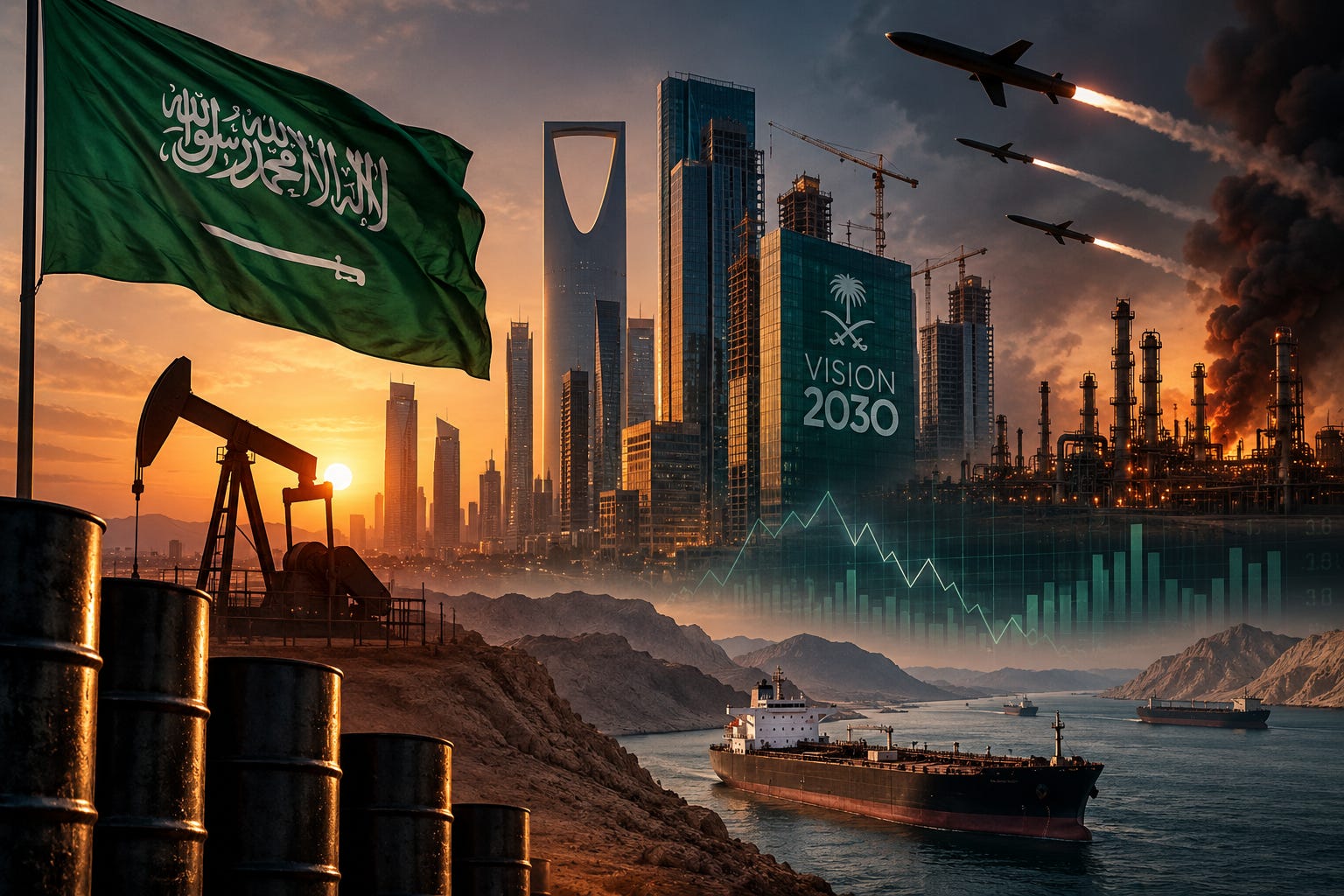
Saudi Arabia’s Vision 2030 was designed to reduce the kingdom’s dependence on oil by attracting foreign capital, expanding the private sector, and building new industries. The regional war is now testing that model from the outside, on top of fiscal pressures that predate it.
The central question is whether Saudi Arabia can sustain its transformation while Houthi missiles and drones are fired at its cities and energy sites, shipping lanes are disrupted, and major projects compete with urgent security needs.
A transformation already under way
Unemployment among Saudis has fallen from 12.3% in 2016 to 7.2%. Private-sector employment among Saudis has risen from 1.7 million in 2020 to 2.6 million, and female labour-force participation has risen from 22.8% to 35%.
The non-oil economy has expanded. The Vision 2030 annual report says non-oil activities now account for more than half of GDP. GASTAT puts real GDP growth at 4.5% in 2025. Oil activities grew by 5.7%, non-oil activities by 4.9%, and government activities by 0.9%.
The war exposes a central vulnerability in the plan: its dependence on investor confidence and secure trade routes.
Foreign investment is the real test
Vision 2030 targets $100 billion in annual foreign direct investment inflows by 2030, or SAR 388 billion a year under the National Investment Strategy. That is more than three times the record gross inflows of SAR 119 billion in 2024.
In the second quarter, gross FDI inflows fell 18% from the first quarter and 16.9% from a year earlier, to SAR 22.3 billion. After SAR 3.2 billion in outflows, net inflows were SAR 19.1 billion.
The second quarter was the first full quarter affected by the regional conflict. The decline reflects weaker investor appetite. The quarterly data cannot separate the war’s effect from pre-existing financial pressures. State and private capital differ. State-backed financing can cushion projects in the short term, but private investors weigh political risk, insurance costs, and the likelihood that a project will generate returns on schedule.
From spectacle to infrastructure
The retreat from Saudi Arabia’s most ambitious projects began before the war. In 2025, the Public Investment Fund ordered deep spending cuts across more than 100 of its companies, after lower oil prices and a cut in Aramco’s dividend squeezed its cash. The Finance Ministry later forecast a 2025 deficit of SAR 245 billion, more than double its initial projection.
The war added a different set of pressures. Shipping through the Strait of Hormuz was severely disrupted, and ports, logistics networks, and digital infrastructure gained strategic value. NEOM halted further work on The Line until at least after 2030, shifting resources to infrastructure, including ports and data centres.
The sequence matters. Funding strain was visible before the war; the halt of The Line was reported in May, three months after the conflict began. The evidence does not show which pressure decided the outcome. The war looks more like an accelerant to an already-underway reassessment than its cause.
The shift reflects both commercial and security calculations. Megaprojects take years to generate returns, while ports and logistics can support trade now. The Port of NEOM is being tested as an alternative trade route, as disruption at Hormuz raises the value of Red Sea access. This is not necessarily a retreat, but it changes Vision 2030’s public promise: from rapid, visible transformation to a longer, more cautious build-out.
High oil prices, shrinking output
The war has created a fiscal paradox. Higher oil prices may support oil revenues, but disrupted production and shipping limit the benefit. In the second quarter, real GDP fell 4.7% year on year, with oil activities down 24.8% and non-oil activities up 0.9%. The IMF’s October World Economic Outlook projects Saudi Arabia’s economy to contract by 3.3% in 2026, before growing by 7.9% in 2027. The July update had projected 1.7% growth for 2026 and 5.5% for 2027. The IMF links the regional downgrade to a longer closure of the Strait of Hormuz. Its baseline assumes the strait reopens in March 2027, with pre-war conditions returning broadly by October 2027.
The projected 2027 rebound would not, by itself, signal a new phase of growth. Much of it would reflect activity lost during the conflict.
The Red Sea workaround
With Hormuz severely disrupted since late February, Saudi Arabia has relied more heavily on the East-West pipeline, which carries crude across the kingdom to Yanbu on the Red Sea. That puts the Red Sea and Bab el-Mandeb at the centre of Saudi economic security, and the workaround is vulnerable.
Drones hit the pipeline on 10 September, and Saudi Arabia shut it as a precaution. Saudi Arabia said the drones came from Iraq; no group claimed responsibility. Saudi Arabia restarted the line on 22 September at a low rate, and its energy minister said on 6 October that flows had reached 5.8 million barrels a day.
Other events remain claims. On 27 October, the Houthis said they hit the Ras Tanura refinery. Saudi Arabia has not confirmed a refinery strike. Alternative routes reduce single-point dependence but do not eliminate risk. A war that disrupts Hormuz, threatens Saudi shipping, and puts energy infrastructure at risk creates overlapping pressure on the kingdom’s export capacity.
The cost of prolonged instability
Reprioritised projects and stronger logistics cannot offset the costs of a prolonged conflict. State funding can cushion the shock, but it cannot substitute indefinitely for private investment, reliable export revenues, and secure trade routes. Vision 2030 is not necessarily derailed, but the conditions for its success have changed. The decisive test is whether Riyadh can protect the infrastructure its economy depends on, restore investor confidence, and sustain diversification without letting security costs and financing pressures undermine its ambitions.