


Saudi Arabia’s regional strategy is a hedge: broaden security partnerships, keep diplomatic channels open with Tehran, and protect its economic transformation under prolonged instability. The war has exposed the kingdom’s vulnerability to attacks on its territory, energy infrastructure, and maritime routes. Riyadh is not abandoning its relationship with Washington. It is still appealing to the United States for more military help while adding partners.
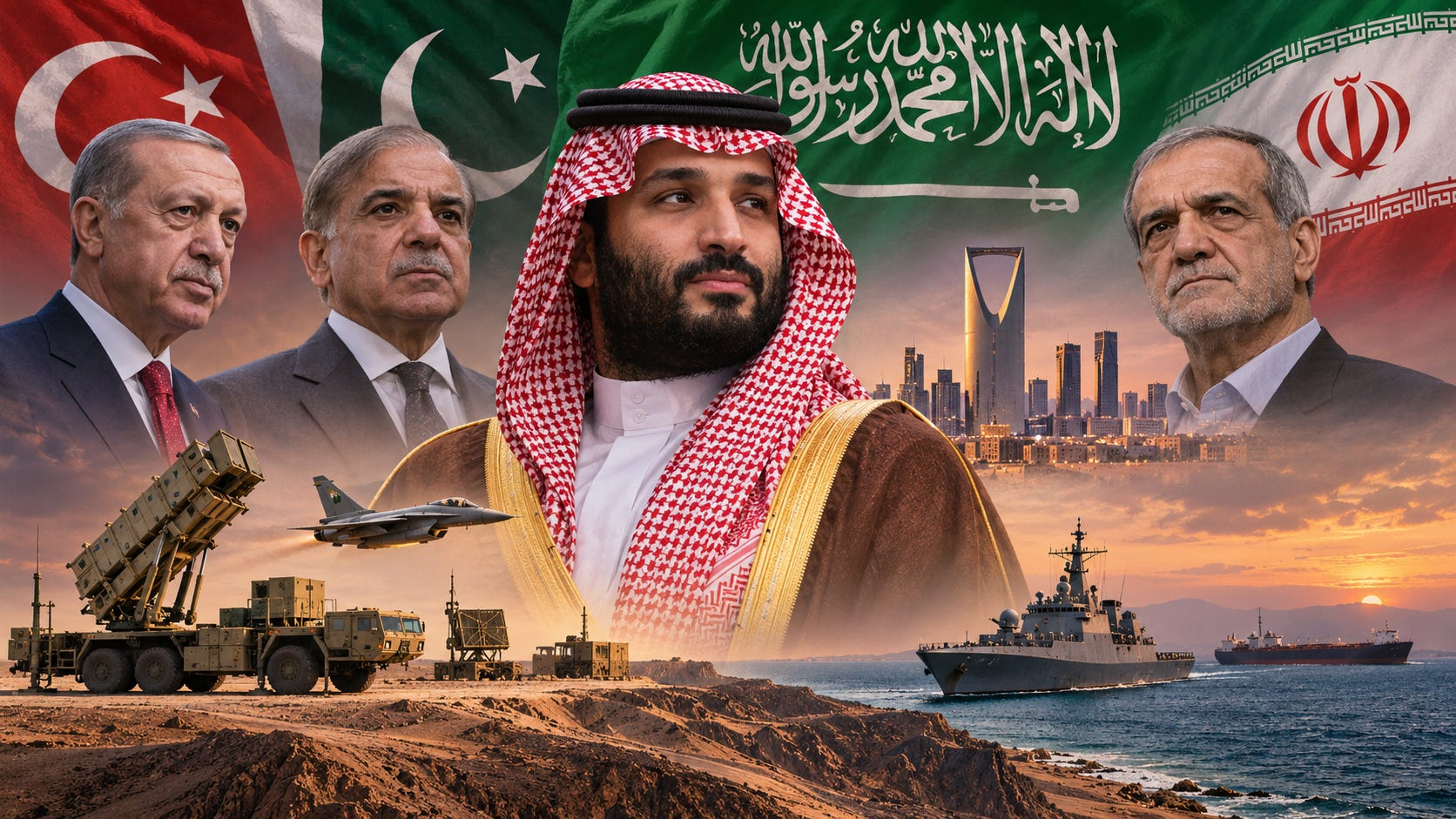
The emerging strategy brings Saudi Arabia closer to Türkiye and Pakistan through the Mecca Joint Defence Agreement. Its value depends on whether political solidarity becomes credible defence without drawing the kingdom into a wider war.
The limits of the American umbrella
For decades, the United States has been central to Saudi security, but the conflict has exposed the limits of relying heavily on one external partner. Saudi authorities confirmed that at least 12 people were killed and more than 300 wounded in the 10 October attack on Riyadh’s airport. The picture is less clear for 27 October, when the Houthis said they fired ballistic missiles at the Ras Tanura refinery and the defence ministry in Riyadh. Saudi authorities did not confirm either strike. The Saudi-led coalition said it intercepted two missiles aimed at Riyadh and three aimed at the Eastern Province, and Saudi Civil Defence said shrapnel from the interceptions damaged property in the capital. A maritime security agency reported a fire near Ras Tanura; Saudi authorities said it was contained, while the Houthi claim of a direct refinery strike remains unconfirmed.
The Mecca pact: promise vs capability
The Mecca Joint Defence Agreement, signed by Saudi Arabia, Türkiye and Pakistan on 7 August 2026, treats an externally originating armed attack on one signatory as an attack against all. It commits the parties to use all necessary means to eliminate threats to one another’s territorial integrity, sovereignty or internationally recognised borders. Support still requires consultation, agreement and action under national law, so it is not automatic.
After renewed Houthi attacks, the three countries activated collective deterrence measures under the pact for the first time. They agreed to provide military forces and capabilities and ensure their rapid deployment to Saudi Arabia, subject to national laws. Whether they have produced operational deployments remains unclear.
Ratification is unfinished: Saudi Arabia and Pakistan have completed theirs. On 27 October, a Turkish parliamentary committee approved the ratification bill, which still needs a final parliamentary vote.
In terms of capability, the pact brings real assets but not yet a combined defence. Pakistan’s reported package includes fighter jets, drones and an HQ-9 air-defence system, alongside Saudi Patriot and THAAD batteries. Türkiye can add air defence, electronic warfare and technical teams. But the three militaries use different systems, and no public evidence shows a common air picture.
On command, the structure is political, not military. The pact’s committee can convene quickly in a crisis, but nothing published says who decides that an attack requires a response, or through which chain of command.
On political will, Riyadh wants protection and more pressure on its attackers. Pakistan wants to avoid another Yemen war or a clash with Iran. Türkiye seeks a larger regional role but faces legal limits on deploying troops abroad. Both have described their role as support, including reconnaissance, while Saudi forces conduct combat operations.
Türkiye: defensive depth, not a replacement
Türkiye’s contribution is technical and industrial: air defence, drone technology, electronic warfare, equipment, technicians, and emergency response support. But Ankara’s limits are legal and political. Türkiye’s constitution requires parliamentary approval for troop deployments; the pact awaits final ratification. Turkish Foreign Minister Hakan Fidan ruled out offensive operations. Ankara has kept air defence and electronic warfare equipment in the kingdom since last year.
Pakistan: defender and mediator
Pakistan is the only partner with forces already in Saudi Arabia: a reported 8,000 troops, a squadron of fighter jets and an air-defence system. Yet it is also positioning itself as a mediator between Iran and the United States. Its limits are domestic and financial: an army stretched by militancy, regional tensions, and an economy constrained by reliance on the IMF. Tehran also holds leverage through border friction, Gwadar, and its ties with Kabul. Islamabad will defend Saudi territory, but fighting in Yemen could require fresh political authorisation. Pakistan is unlikely to confront Iran directly.
That tension was visible on 26 October, when Saudi, Pakistani, and Turkish officials met Iranian President Masoud Pezeshkian in Tehran. The four sides agreed to continue dialogue; Saudi Arabia said the meeting aimed to prevent a return to escalation.
Diplomacy as a security instrument
Engagement with Iran does not mean Saudi Arabia’s security concerns have disappeared. Tehran’s role is substantial but not absolute. Iranian support has helped the Houthis conduct more potent attacks, including through targeting intelligence. A senior Saudi diplomat says Iran continues to arm, train, and support the group. Influence is not control. Iran can shape the escalation without ordering the Houthis to abandon gains around Mocha or Bab al-Mandeb. Tehran appears to treat Houthi restraint as part of broader bargaining with Washington, while the Houthis’ own conditions, including an end to Saudi Arabia’s air blockade, remain outside its gift. Even after the 26 October Tehran meeting, continued Houthi attacks show that diplomacy has not yet reduced the threat.
The Strait of Hormuz remains central to this vulnerability. Since Hormuz was severely disrupted, Saudi Arabia’s East-West pipeline has provided an alternative route to Yanbu on the Red Sea. No alternative infrastructure can eliminate risks to energy exports and maritime commerce. The pipeline was temporarily shut in September after a drone attack that Saudi officials said originated in Iraq. Threats around the Red Sea and Bab el-Mandeb connect Saudi security directly to Yemen.
The cost of hedging
Saudi Arabia’s economic transformation gives Riyadh a powerful reason to contain the war. Vision 2030 depends on investor confidence, reliable trade routes and the perception that the kingdom can protect critical infrastructure. Missile interceptions, pipeline shutdowns and shipping disruption raise insurance, logistics and financing costs; they also make long-term private investment harder to price.
The strategy may improve air defence and diplomatic options. But it will not deliver credible collective defence without shared command arrangements, pre-positioned capabilities and a clear response mechanism.
Saudi Arabia’s hedge is a rational response to a more dangerous region. Its success will be measured by whether it makes Saudi territory, energy exports, and economic transformation harder to disrupt.