



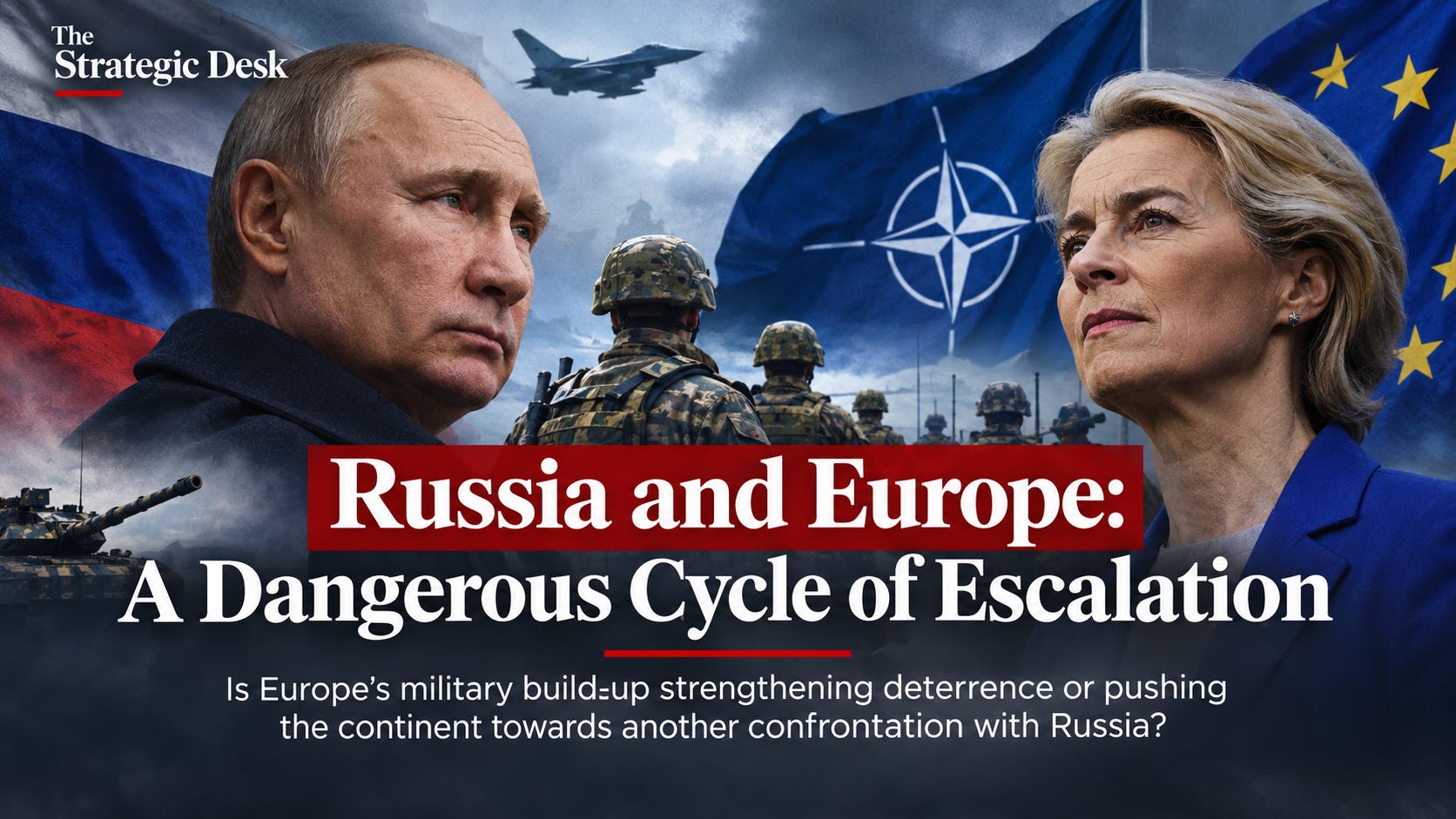
Europe is about to enter a new era of military competition. The war in Ukraine has disrupted European security and led to a surge of military spending, new military deployments and enhanced readiness along NATO’s eastern flank. For its part, Moscow perceives NATO’s recent military deployments as a threat to Russian security.
This leaves us with an important question: is the rearmament in Europe simply rebalancing of power, or could it create a spiral of hostility that will be more and more difficult to avoid one more European bout? To answer it, we need to delve into the security considerations of Russia and European states.
The return of military competition
Europe’s rearming can be seen in individual defence budgets and military deployments. The UK has adopted a “NATO First” approach and announced it would accelerate its military build-up in Estonia, to 1,200 troops. France increased its 2024-2030 expenditure plan by another €36bn and devoted additional funds to ammunition, drone and air defence. Poland allocated some PLN 200.1bn for its national defence in 2026, which amounted to 4.8 per cent of the country’s GDP.
NATO’s eastern-flank deployments further illustrate this shift. The UK leads the multinational battlegroup in Estonia, Canada leads the one in Latvia, Germany leads the one in Lithuania, and France leads the presence in Romania. NATO describes these deployments as defensive deterrence, intended to protect member states against potential aggression.
But Moscow sees it in a different light: NATO expansion, military exercises and the troop build-up of the alliance is considered by Russia to threaten its security as it aims ever more effortfully at moving NATO infrastructure ever closer to Russia’s borders. To Russia, European military activities and NATO alliance build-up are perceived as destabilising.
Russia’s security concerns and Europe’s response
Post Cold-War NATO expansion, including Poland, the Czech Republic, and Hungary. NATO also admitted Finland and Sweden. Moscow claims that the post Cold-War expansion has extended NATO’s military infrastructure toward Russia.
Nevertheless, NATO enlargement has largely involved sovereign states seeking membership because of their own security concerns and historical experiences. Countries such as Poland, Estonia, Latvia and Lithuania have the right to choose their security arrangements. Their decisions cannot simply be described as Western efforts to encircle Russia.
At the same time, Russia’s security concerns should not be dismissed. The problem is that NATO sees its deployments as needed to serve deterrence, and Moscow sees them as a way of applying strategic pressure. So the military moves of one side are viewed as a further threat to the other, and vice versa. This is the essence of the security dilemma.
Germany’s rearmament: lessons from history
Another expansion is the German military. Berlin intends to make the Bundeswehr Europe’s strongest conventional armed forces by 2039. Around €109.7 billion has been budgeted for German defence in 2026, the Bundestag notes. The proposed 2027 budget is for €139.6 billion, including regular expenses and Bundeswehr special fund funds.
However, the comparison with the 1930s should be made carefully, even as Germany’s rearmament draws parallels to that era. Nazi Germany’s military expansion was part of an openly expansionist project involving treaty violations and territorial aggression. Contemporary Germany presents its military development as part of NATO’s collective defence arrangements, not a project of territorial conquest.
Indeed, the 1930s also offer another lesson: insufficient military preparedness can weaken deterrence and encourage aggression. Some European governments therefore argue that rearmament is necessary to prevent potential adversaries from believing that military action would face little resistance. The challenge is to strengthen defence without allowing military competition to replace diplomacy.
Diplomacy and the growing atmosphere of mistrust
The Abu Dhabi negotiations also exposed a disagreement over who should participate in decisions about Europe’s security. Although the talks were formally trilateral between Russia, Ukraine and the United States, European representatives held separate consultations with Ukraine and Washington. European governments argued that any settlement could reshape the continent’s security architecture and therefore should not be reached without their involvement. Moscow rejected this position, questioning the role of governments that have supplied Ukraine with military assistance. Russian chief negotiator Vladimir Medinsky dismissed the European representatives as “tourists“ and said Europe could participate when its “conscience awakens.” Yet an important distinction remains: European states may have legitimate interests in the outcome without necessarily being parties to the negotiations themselves. The question, therefore, is whether consultation is sufficient, or whether Europe is seeking a direct negotiating role beyond its status as an external stakeholder.
Mistrust is also evident in the recent European flight disruptions caused by hoax bomb threats. Although Russia and Iran were discussed in the wider context of possible interference, reporting indicated that the perpetrators had not been identified and no government responsibility had been established. This demonstrates why suspicion must not be confused with evidence. Premature attribution can further damage diplomatic relations in an already tense environment.
Conclusion: deterrence without diplomacy is not enough
European governments have reason to strengthen their defence forces in light of Russia’s invasion of Ukraine. Moscow’s apprehensions about NATO building up its military also help to explain why Russia objects to Europe’s transformation of its security architecture.
Another warning has been recent bomb threats that led to cancellations and disrupted flights across Europe. While there was speculation that state security agencies could be involved in light of the tense geopolitical climate, officials had not accused any government or identified who was responsible. [12]
Europe may not be heading for a new war merely because its governments are rearming. Nor can armed conflict be averted entirely by the possession of armaments. The bigger challenge for Europe is whether it can break out of a dynamic where the requirement of the other side to act military is interpreted as a threat. Unless there is credible deterrence and a diplomatic interaction to manage divergent security interests, Europe’s future may lie in stagnation.
Follow The Strategic Desk for independent geopolitical analysis, in-depth reporting and strategic insights into the forces shaping our world. Subscribe, share this article and join the conversation. Understanding today's tensions is essential to anticipating tomorrow's conflicts.