

An educated workforce is indispensable for a thriving society. You may have learned in Economics 101 that labour is a factor of production and therefore central to a country’s growth and development. Nevertheless, we live in an age when information is becoming an important commodity alongside minerals and fossil fuels. How we access, consume, and use information influences the quality of the labour force in the years to come.
With widespread digitalisation and the use of Artificial Intelligence (AI), students’ long-term employment prospects are at risk. The Programme for International Student Assessment (PISA) is a global comparative assessment of 15-year-old students’ competency in mathematics, reading, and science. Simply put, it shows how students perform in core competencies and reflects their readiness and adaptability as they enter the labour force.
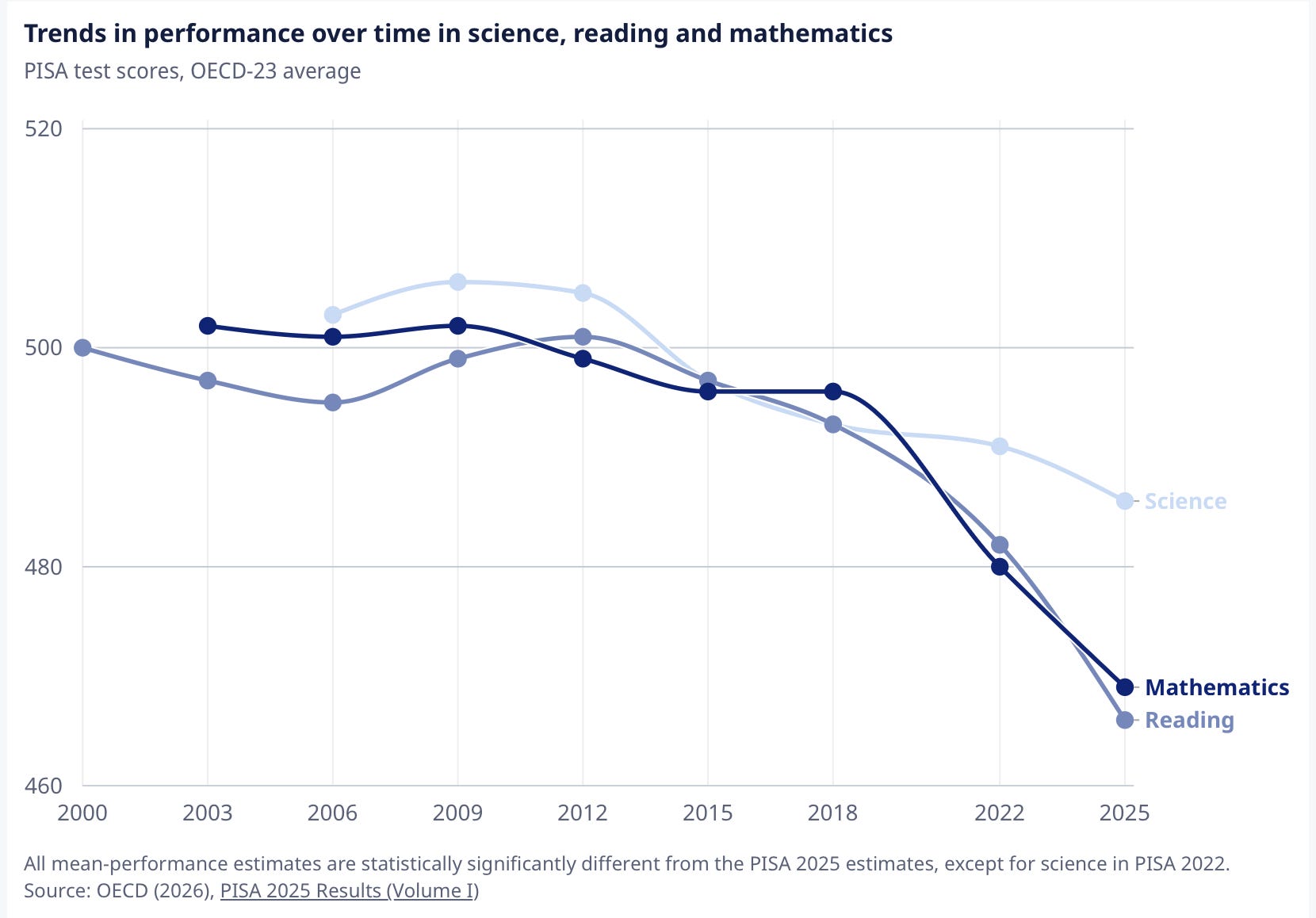
In the PISA 2025 Results, the three competencies mentioned above, especially reading, continue to decline.
The relationship between AI utilisation and student performance is more complicated. Non-AI student users outperform their peers in “summarising texts or conducting research”, while students who frequently use AI for general purposes, along with opportunities at school to build AI literacy skills, have slight advantages in science test results. These results reveal deeper problems with using AI: access to AI and the means to enhance AI literacy skills. While disparities in AI utilisation already exist, the world’s poorest communities have less access to AI and, by extension, students in these disadvantaged areas.
While others may argue that an advanced education may mitigate these declining competencies, a 2026 International Labour Organisation (ILO) report posited that individuals aged 15 to 24 with an advanced education “face greater risks of automation” than their less educated peers. Hence, advanced degrees do not insulate the future labour force from the risks associated with automation. This brings us back to reading: an undeniably fundamental skill not only to adapt to this digitalised, information-driven economy but also to think critically and solve old and new problems.
If we look more closely at the graph above, the decline in reading competency began around 2012. According to the PISA report, the decreasing levels of reading may be attributed to the shift towards “digital reading”, such as scrolling on social media, which is detrimental to how students engage with complex text or data (p. 6). The rise of smartphones in the early 2000s and the wide variety of options from Facebook, Instagram, and X (Twitter) supported the prevalence of social media. Beyond Australia’s ban on social media for youth under 16, other jurisdictionsare also discussing similar policies or regulations, emphasising the growing risks of social media on youth.
This article will not delve into debates about whether to impose a social media ban in your homes, but will instead emphasise the importance of reading, as it underpins other competencies (i.e., science and mathematics). In the World Economic Forum’s Future of Jobs Report 2025, “analytical thinking remains the most sought-after skill among employers” (p. 6). We cannot expect the future labour force to be analytical thinkers if we don’t encourage them to take time to read beyond social media and cultivate a reading culture. As a society, we need to appreciate reading as more than a skill, but as an activity that helps us become critical thinkers and develop empathy for our fellow human beings. We need to preserve the reading culture of the youth, and even adults, for an adaptable labour force and thriving society.
Written by Marius Torres, The Strategic Desk
If you want to understand the forces shaping politics, economics, technology and the world around us, subscribe to The Strategic Desk.
We go beyond the headlines to explain what is happening, why it matters, and what could come next.
Subscribe to The Strategic Desk and stay informed.