


“(Trump) is trying to preach the end of multilateralism, trying to strengthen unilateralism. I think multilateralism will win.” Brazil’s President Luiz Inácio Lula da Silva made these remarks at the G20 summit in Johannesburg in 2025. His comments reflect a wider debate over the future of the international order. The world order built by the United States after 1945, established on American strength, open markets and a vast network of alliances, is under siege. American leadership faces growing challenges, and competition between Washington and Beijing is intensifying. Countries such as India, Japan, Türkiye and Saudi Arabia are seeking greater room to manoeuvre. Rather than committing themselves exclusively to one major power, these middle powers are pursuing flexible partnerships to protect their national interests.
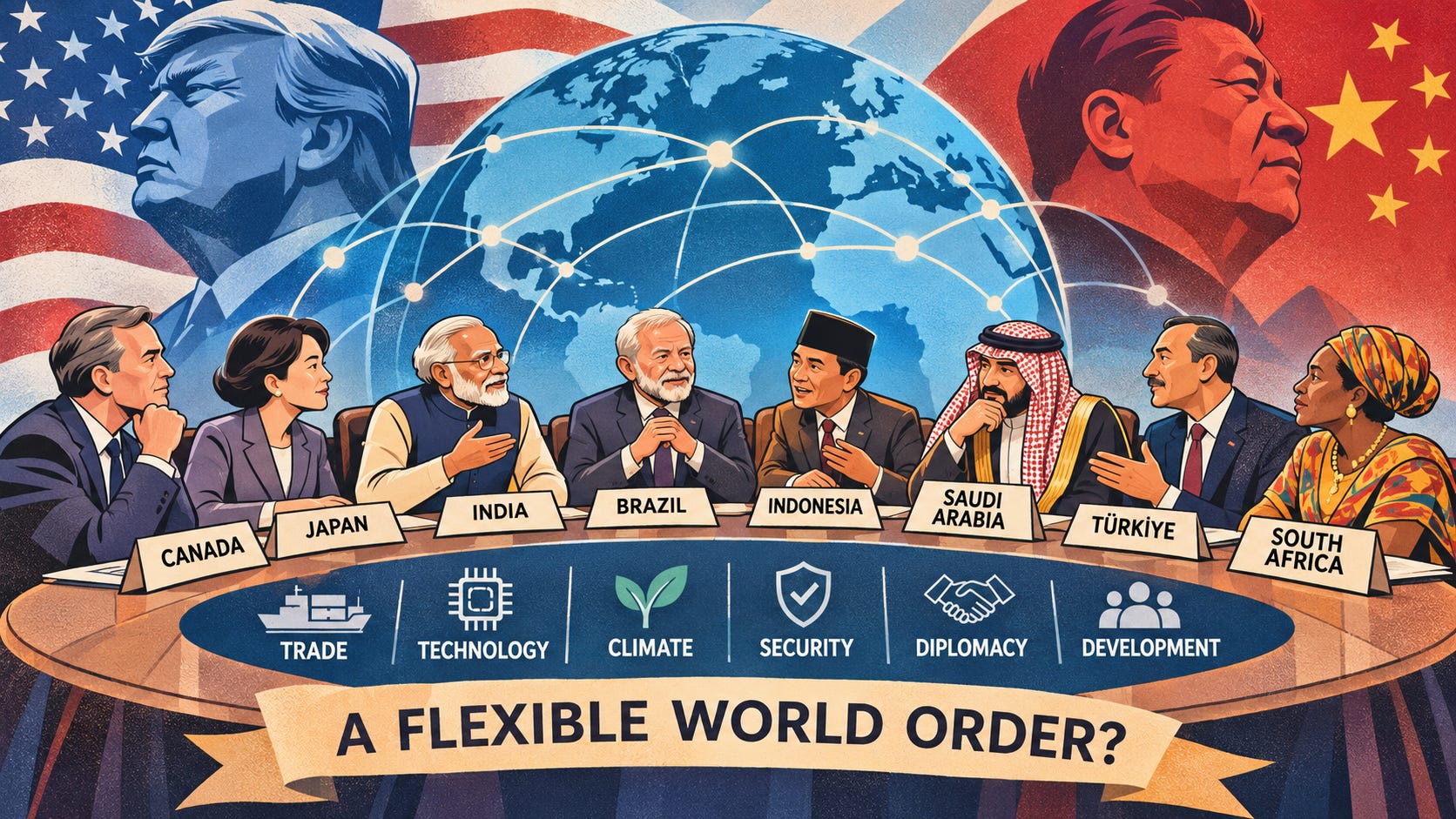
Middle powers are at the centre of this transition. They are either helping to shape a more cooperative international order or accelerating its fragmentation. Middle powers are neither great powers nor small states. They possess enough economic, diplomatic, military or technological influence to affect events beyond their borders, but not enough material power to reshape the international system without assistance. Examples of countries in this category include Brazil, India, Indonesia, Japan, South Africa, Türkiye, Saudi Arabia, Australia, Canada and Nigeria. In response to the current escalation in great-power competition, their significance has increased. The international system is largely shaped by major powers, but many global issues cannot be addressed by them alone. These include climate change, supply chain disruptions, energy security, refugee and humanitarian crises, and regional conflicts. This gives middle powers leverage to play a diplomatic role through mediation and regional cooperation.
However, we should not mistake “leverage” for “collective unity”. There is no coherent “middle power movement”. Unlike the Non-Aligned Movement, which sought to establish a collective political position during the Cold War, contemporary middle powers do not operate through a unified organisation or shared ideological agenda. Their cooperation is generally selective, issue-specific and shaped by national interests. This means avoiding full alignment with any single great power while maintaining ties with competing powers. The goal is to ensure strategic independence, maximise economic advantages, maintain economic security options and minimise the risk of being drawn into a great-power struggle. Indonesia calls its policy “dynamic equilibrium,” characterised by multipolar relations without formal strategic alliances. Meanwhile, India is part of both the Quad and BRICS. Brazil maintains strong economic and diplomatic ties with China and the United States. The Government of Canada, led by Prime Minister Mark Carney, has proposed a framework of “variable geometry,” meaning different coalitions depending on the issue at hand. Middle powers are increasingly looking to form flexible coalitions around specific issues such as trade, technology, climate and security.
Japan provides an example of this approach. Through partnerships with Australia and other countries, it has expanded cooperation in areas such as critical minerals, infrastructure and supply chain resilience. Its involvement in Southeast Asia has also been built on long-term economic ties, development aid and capacity-building initiatives. These connections can raise the costs of economic coercion by providing states with more market, supplier and diplomatic options. The outcome is not a new alliance system, but an expanded network of relationships designed to ensure strategic autonomy.
The concept of a “multiplex world”, developed by Amitav Acharya, is a particularly good fit in this context. In contrast to the traditional multipolar arrangement dominated by a few competing great powers, a multiplex order is composed of overlapping institutions, regional organisations, middle powers, businesses and other actors operating from several centres of influence. Great powers remain relevant, but they no longer have a monopoly on influencing every issue. In this context, middle powers may influence coalition formation, niche diplomacy, agenda-setting and the process of bringing different actors together. It is important to note that middle powers are not necessarily balancing against the United States. Instead, they are following a policy of diversified alignment, balancing relations with rival great powers to guarantee strategic autonomy and avoid dependence on a single power.
Examples of this influence are already emerging. The recent Makkah Joint Defence Agreement, signed on 7 August 2026 by Saudi Arabia, Pakistan and Türkiye in Makkah, illustrates how middle powers can diversify their security partnerships without necessarily balancing against the United States. Under Article 2, an external armed attack against one member is considered an attack against all. The agreement also encourages defence-industrial cooperation and joint production, enabling Saudi Arabia to strengthen its domestic defence sector and reduce its dependence on foreign security providers. This is not anti-American alignment, but strategic diversification. Indonesia has been involved in diplomatic efforts surrounding conflicts and regional disputes. Brazil has raised issues of hunger and poverty at the G20, while South Africa has pushed issues such as African debt and climate finance onto the agenda during its G20 presidency.
These are examples of how middle powers can have a significant impact, even without the military and economic strength of great powers. However, bringing countries together and establishing ambitious goals is easier than translating those goals into lasting institutional change. Brazil’s Global Alliance Against Hunger has nearly 148 members and aims to reach 500 million people. However, the execution of the Global Alliance relies heavily on voluntary funding and long-term political investment. Likewise, the recent focus on Africa’s debt and climate finance in South Africa has brought attention to key structural inequalities. However, major institutions of global finance, such as the IMF, the World Bank and the dollar-dominated financial system, remain largely governed by the world’s major powers. Rather than constituting an anti-American balancing coalition, the growing diversification of middle-power partnerships reflects an effort to manage asymmetrical dependencies and preserve strategic autonomy in an increasingly competitive international order.
This does not mean that middle powers are not constructing a new “flexible world order”. Instead, they are adapting to a world in which no single power can consistently lead the international system or serve as an effective referee. They can play a role in maintaining cooperation when broader consensus is difficult to achieve. They can also build issue-specific coalitions, diversify economic relations, mediate conflicts and minimise strategic interdependence. The emerging order will not necessarily see one system replace another. Rather, countries will have to learn how to function in an increasingly fragmented and dynamic world. Middle powers are not collectively challenging the existing hierarchy. They are becoming better at managing it: hedging where appropriate, cooperating where possible and developing sufficient partnerships to maintain their room for manoeuvre.
Enjoyed this analysis? Subscribe to The Strategic Desk for independent insights into geopolitics, global affairs and the forces shaping our world. Share this article and join the conversation.