



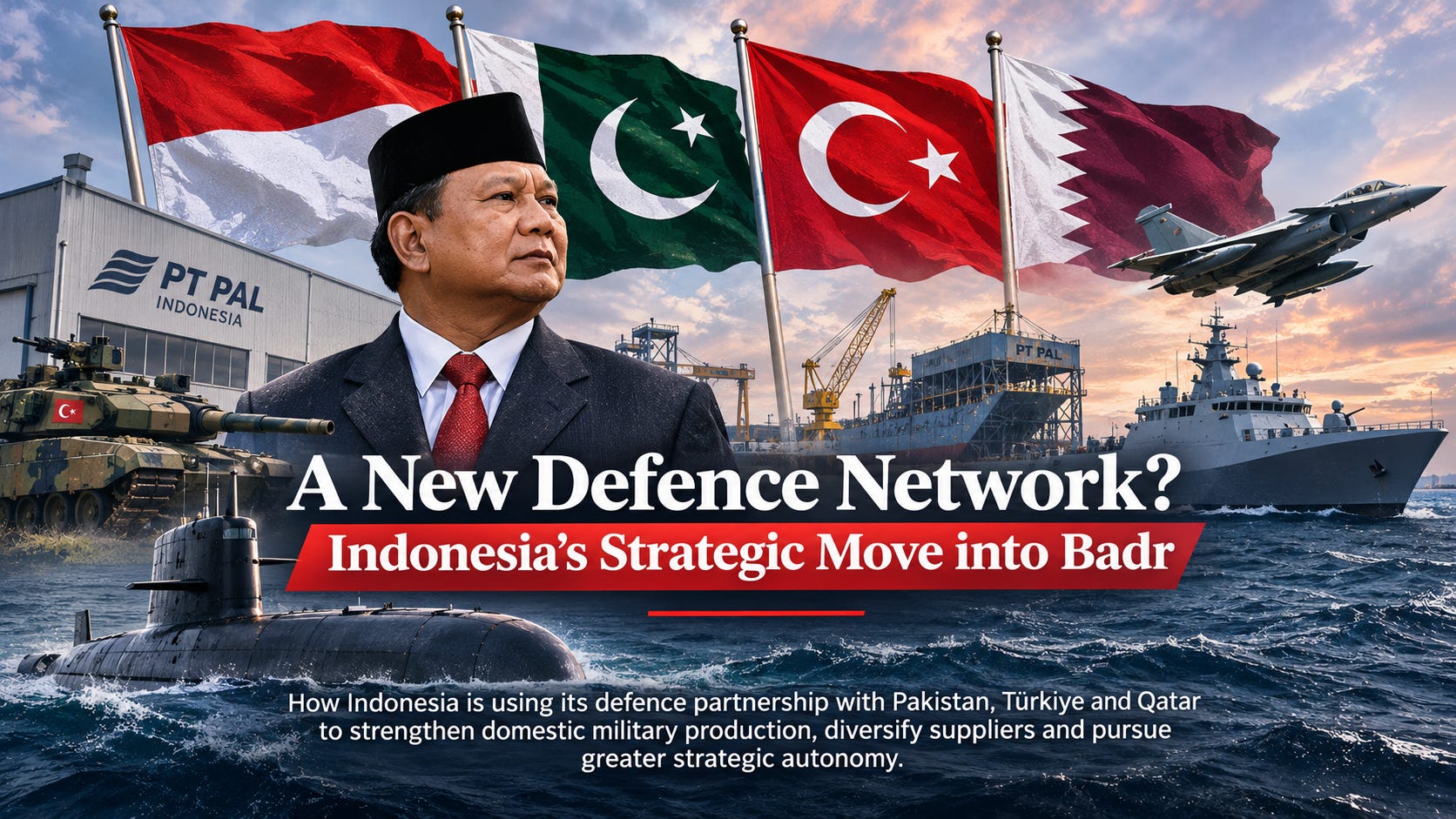
“We aim to strengthen our national capabilities,” Indonesia’s Foreign Ministry spokesperson Vahd Nabyl A. Mulachela said on 22 October 2026, explaining Jakarta’s decision to join the Badr defence cooperation agreement with Pakistan, Türkiye and Qatar. The statement reflects an important goal of Indonesia’s defence policy: upgrading its armed forces and gradually developing domestic capabilities for the production and maintenance of military equipment. Jakarta has stated that it will “leverage” the partnership to strengthen its own defence manufacturing and diversify its suppliers, rather than create an “anti-Western bloc.” The agreement explicitly focuses on combining industrial strengths, not on mutual defence commitments. The submarine programme is a good example of this approach. Over the past fifteen years, Indonesia has acquired submarines from South Korea, pursued technology transfers from France and begun constructing advanced submarines at its own shipyard. Badr provides another opportunity to connect international defence partnerships with domestic industrial development.
Maritime security is a key defence priority for Indonesia because of its geographical position. Indonesia stretches approximately 5,000 kilometres from west to east across the equator, between the Indian and Pacific Oceans, and consists of 17,380 islands, according to the national map released by Indonesia’s Geospatial Information Agency (BIG) in 2025. It also occupies a strategic position along key shipping lanes, particularly the Strait of Malacca, Sunda Strait and Lombok Strait. These waterways connect two oceans and are important for international trade and strategic traffic. Indonesia’s maritime zone covers more than 6 million square kilometres, encompassing its territorial waters, archipelagic waters, exclusive economic zone and continental shelf. This vast maritime area cannot be defended by traditional land-based forces alone. The Indonesian National Armed Forces (TNI), including the army, navy and air force, have therefore pursued modernisation through equipment procurement and domestic production projects.
In December 2011, Indonesia signed a contract with South Korea’s Daewoo Shipbuilding and Marine Engineering (DSME) for three Nagapasa-class submarines, based on the Chang Bogo design. The first two were built in South Korea, while the third, KRI Alugoro, was built at PT PAL’s Indonesia (Persero) shipyard in Surabaya with technical assistance from South Korea. Alugoro was launched in April 2019, marking a significant milestone in Indonesia’s submarine-building programme. However, the programme also illustrated the limitations of local production at the time, with many of the submarine’s components being sourced from elsewhere.
Additionally, on 28 March 2024, Indonesia signed a contract with Naval Group and PT PAL for two Scorpène Evolved submarines equipped with lithium-ion batteries. The agreement provided for both vessels to be built in Indonesia through technology transfer. The contract came into effect on 23 July 2025. Naval Group outlined plans to train more than 400 Indonesian engineers, with approximately 50 French experts providing technical support in Indonesia. On 7 August 2026, PT PAL held the steel-cutting ceremony for the first submarine, formally beginning construction. The project is expected to take around 96 months.
PT PAL is responsible for construction, equipment integration, testing and final assembly, while Naval Group provides design expertise, engineering support and technical assistance. The arrangement is intended to develop Indonesian capabilities in submarine construction, maintenance and operation. It is an example of the type of industrial cooperation that Jakarta would like to encourage. Additionally, it supports industrialisation and capacity-building through the integration of foreign technology with local production.
Indonesia’s procurement strategy is not limited to submarines. The first three Rafale fighter aircraft were delivered to the country in January 2026 under a contract for 42 aircraft. Its naval acquisitions also include two Scorpène submarines from France and Italian-built Thaon di Revel-class frigates. Cooperation with Türkiye has produced the Harimau medium-weight tank through a partnership between FNSS and Indonesia’s PT Pindad. Eighteen tanks had been delivered by October 2024. In addition, a partnership between two companies, Indonesia’s Republikorp and Türkiye’s Baykar, has been announced for drone production.
Indonesia is diversifying its defence suppliers rather than relying on a single country. However, this approach also presents challenges. Equipment from different manufacturers can create difficulties with maintenance, training, logistics and interoperability. The International Institute for Strategic Studies (IISS), in its 2023 Military Balance, highlighted the difficulty of creating a coherent fleet from an increasingly diversified acquisition portfolio in its assessment of Indonesian naval modernisation. The problem is not simply acquiring modern platforms, but also operating, maintaining and integrating them within Indonesia’s military structure.
Several companies play a major role in the growth of domestic manufacturing, including PT PAL, PT Pindad and PT Dirgantara Indonesia. However, research capacity, a skilled workforce, investment and coordination between government institutions, universities and industry remain important limitations. Analysts have identified weaknesses in Indonesia’s defence-industrial development. They have discussed the “Triple Helix” model proposed by the government to connect academic research, industrial production and military requirements.
The Triple Helix Model provides insight into the relationship between government, universities and industry as actors in the innovation process. In the case of indigenous modernisation in Indonesia, the government sets priorities, universities conduct research and provide technical support, and defence companies such as PT PAL and PT Pindad use the resulting research to develop defence products. This collaboration is reflected in the Scorpène submarine programme, which involves government procurement, technology transfer from France and local construction by PT PAL. Badr has the potential to expand these collaborations internationally through joint research, technology transfer and industrial cooperation.
Geopolitical Significance of Badr
The Badr agreement establishes cooperation among Indonesia, Pakistan, Türkiye and Qatar in research and development, technology transfer, industrial manufacturing and human-resource development. Indonesia’s Ministry of Defence (Kemenhan) has presented it as an effort to strengthen national capabilities and build a unified defence-industrial ecosystem. Explaining Jakarta’s motivation on 22 October, the spokesperson said: “Indonesia is working with the countries that can help us build our capacity.” He also identified the diversification of defence partnerships and the strengthening of global supply chains as key objectives.
Each Badr partner brings a unique combination of capabilities. According to analysts, Türkiye has advanced technological expertise and a mature defence industry, including drones, armoured vehicles and naval systems. Pakistan has established manufacturing and maintenance capabilities, including shipbuilding and munitions production, alongside a large skilled workforce. Indonesia contributes a sizeable industrial base and market, with growing defence companies and infrastructure, from shipyards to ordnance factories, that can support joint production. Qatar brings significant financial resources and procurement needs. It has also been developing defence ties with several partners and has the capacity to invest substantial funds in joint projects. As one analyst put it, “Türkiye brings technology and expertise, Pakistan and Indonesia bring manufacturing capacity, skilled workforce and large domestic market, and Qatar brings the investment potential and demand”.
Many of these countries already have bilateral defence links. For example, Pakistan and Türkiye are jointly building naval ships through the PN MILGEM Babur-class corvette project, with some vessels being built in Karachi. Indonesia and Türkiye have also collaborated on developing a new tank. Cooperation between Türkiye and Indonesia provides a good example of the type of partnership Indonesia could pursue with other nations. The two countries have established partnerships for the production of Harimau tanks and drones, demonstrating that these partnerships are not simply about purchasing equipment.
Badr may create opportunities for longer-term orders and joint development in areas such as aerospace, maritime and land systems, providing all partners with greater industrial capacity. Pakistan’s Defence Minister, Khawaja Asif, described it as a “good opportunity” for “joint production, technology transfer and greater self-reliance” with “trusted partners”. The Badr agreement should be viewed as an effort to hedge and pursue strategic autonomy, rather than as an anti-US or anti-Western initiative. There is no mention of any adversary in the agreement, unlike a formal alliance established against a specific power. Its diplomatic language emphasises mutual defence-industrial support and regional peace and stability. Indonesia has reaffirmed its “independent and active” foreign policy (bebas-aktif) and continues to balance its relationships with the US, China and other powers, even as it pursues new defence partnerships.
From a practical perspective, Badr provides Indonesia with additional sources of supply. In recent years, Jakarta has acquired Rafale jets (France), Black Hawk helicopters (USA) and drones (USA and Türkiye), while building submarines with South Korea and France. The agreement opens up new opportunities for suppliers and investment in such projects through engagement with Qatar, Pakistan and Türkiye. For example, Turkish systems, including drones, UAVs and electronics, could be partially assembled in Indonesia under new agreements. Indonesia is the largest arms importer in Southeast Asia. It was ranked 18th among the world’s largest arms importers in 2021–25, receiving approximately 40% of its imports from Italy, followed by France and the US. Indonesia’s modern military equipment is largely developed outside the country, as demonstrated by this Western-centric procurement portfolio. However, Jakarta’s “aspiration for self-reliance… cannot succeed without international cooperation in technology transfer, co-production, and market access.”
Interested in the future of global defence and geopolitics? Subscribe to The Strategic Desk for independent analysis of the partnerships and strategic decisions shaping our world. Share this article and join the conversation.