


Author: Hafsa Qadri
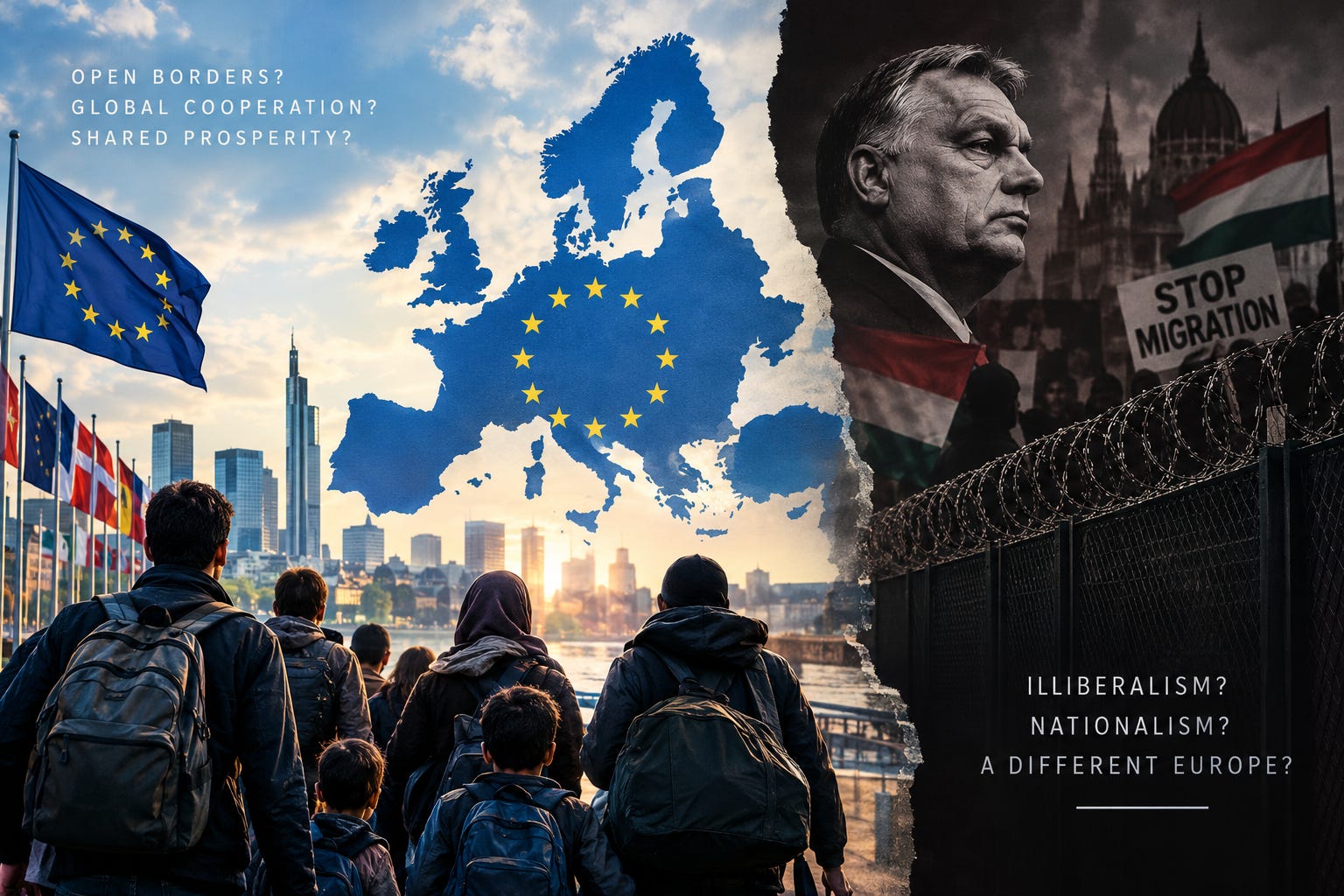
The surge of anti-immigrant sentiment and far-right parties sweeping across Europe adds yet another layer to the increasingly contested issue of migration. It has also given a new lease of life to the term “illiberalism.” The concept gained renewed prominence through Hungarian Prime Minister Viktor Orbán’s 2014 speech, in which he described Hungary’s emerging political model as an “illiberal state.” Illiberalism describes a political ideology or system of government that is characterized by retaining formal democratic institutions while weakening or eroding the liberal values, such as judicial independence, press freedom, civil liberties, and institutional checks and balances, that uphold them. It is very often associated with nationalist and populist rhetoric designed to “protect” the real “people” from political elites, minorities, and outside influence.
Today, immigration is one of the most common issues on which these movements present their ideology. The “other” is represented as a competitor for economic goods as well as an “outsider” to the national community, portrayed as a menace to the common cultural identity and national sovereignty. This is also one of the factors that has underpinned the electoral success of far-right parties.
This article explores the impact of the growth of illiberalism on European immigration politics and the future of the openness and pluralism of liberal globalization.
What Are the Rising Illiberal Trends in Europe?
To sum up, illiberalism’s increasing popularity in Europe can be understood along three major dimensions. The first relates to cultural identity and one’s sense of belonging to one’s nation. Illiberal and right-wing populist parties tend to identify immigration as a destabilizing force for local culture, religion, and national identity. They play on people’s fears by creating a narrative in which migrants are outsiders threatening the status quo and worsening relations with their own communities.
Italy provides a recent example. On 24 September 2026, Italy’s Council of Ministers approved a school decreeintroducing a ban on burqas and niqabs in schools and a 30% cap on certain categories of foreign pupils in first-year primary-school classes. Under the government’s stated criteria, the cap applies to pupils with non-Italian citizenship who were not born in Italy or had not attended at least two years of preschool. The government has presented the measures as promoting integration, language learning, and equal educational opportunities. While language support and educational integration are legitimate policy concerns, restrictions involving religious dress also raise questions about religious freedom and the relationship between cultural diversity and national identity. The measures illustrate how debates over integration can become embedded in government policy, particularly when educational and cultural questions intersect with broader concerns about national identity.
The second dimension is economic insecurity. Certain segments of the native population may view immigrants as threats to resources such as jobs, wages, career opportunities, housing, or services. These concerns can be mobilized politically when populist far-right parties link economic insecurity to migration and identify migrants or entrenched political classes as the culprits behind declining living standards.
The rise of the Alternative for Germany (AfD) also illustrates how economic insecurity can create fertile ground for far-right politics. A recent analysis by Dr Patrick Kaczmarczyk of the AfD’s strong showing in Saxony-Anhalt points to the region’s history of economic disruption following reunification, including structural shifts, job losses, population decline, and industrial decline. The region continues to face stagnating wages, industrial uncertainty, and pressure on household purchasing power. These factors do not, on their own, account for support for the AfD: migration, nationalism, opposition to Western support for Ukraine, and mistrust of established political institutions also remain central. However, economic precarity can create an environment in which such political grievances are more easily translated into electoral support.
The third dimension concerns political distrust and the normalization of illiberal ideas. When segments of the population become disillusioned with mainstream political parties because they feel they have been ignored on cultural and economic issues, they may turn to far-right parties to fill that gap. By attacking and criticizing the political status quo for being out of touch with the public, these parties allow more extreme views on immigration to enter the political mainstream.
A 2025 study by Franziska Wagner, Dean Schafer, and Mehmet Yavuz, published in Politics and Governance, examines 67 parties across eight European countries over a 15-year period. The researchers find that mainstream parties, particularly conservative ones, tend to follow shifts in the immigration discourse of far-right parties. This suggests a mechanism through which far-right movements can influence mainstream politics: by making immigration more electorally salient, changing the terms of public debate, and increasing pressure on established parties to adopt or emphasize more restrictive positions. This process does not mean that mainstream parties simply adopt far-right ideologies. Their responses may also reflect voter preferences, coalition calculations, administrative pressures, and wider debates about border management. Nevertheless, when restrictive positions become more widely accepted across the political spectrum, ideas once associated primarily with the far right can become normalized within mainstream political discourse.
How Illiberalism Takes Hold in Europe and Challenges Liberal Globalization
Liberal globalization usually describes an open and interconnected world underpinned by transnational international cooperation and the free exchange of goods, ideas, and services. This involves the ease with which people, goods, ideas, and capital can move around the world. Illiberal nationalism brings this open world into question, particularly with regard to migration.
Hungary under Viktor Orbán exemplifies this. His government built a border fence along the Hungarian border with Serbia in 2015 in response to the flow of refugees and migrants. Orbán has also employed language that casts migration, especially from predominantly Muslim countries, as a threat to the Hungarian nation and Hungary’s independence. Although border policing is a common instrument of state policy, the Hungarian case exemplifies how border policies can also take on symbolic meaning when political communities cast border control as a means of protecting a defined national or cultural identity. The border then becomes something more than a way of limiting mobility. It can also symbolize who belongs and who does not.
The threat to globalization inherent in illiberalism thus goes beyond economic protectionism. It also involves opposition to certain forms of social and cultural openness, particularly where immigration is regarded as an affront to local mores. However, illiberalism does not necessarily mean an aversion to globalization. Political actors may still favour globalization in the form of trade, investment, or strategic cooperation while opposing immigration and limiting the spread of cultural diversity. Their stance should instead be understood as an attempt to redefine openness selectively, accepting some forms of openness while rejecting others.
Liberal globalization is not the same as free migration or the abolition of national borders. It is possible for states to control immigration while still upholding their obligations to international cooperation, rights, and pluralism. The problem arises when immigration controls are embedded in a larger political project that erodes protections for minorities, constrains conceptions of national identity, or dismantles liberal institutions that limit state authority.
Economic concerns, public suspicion of political institutions, electioneering, and contestation over sovereignty all influence public attitudes and government preferences. However, far-right parties have the capacity to shape debates around these issues in relation to immigration and culture. When larger parties emulate that rhetoric or advance more restrictive proposals, the “Overton window” of permissible political discourse changes. It is neither inevitable nor uniform that right-wing parties govern according to a dog-whistle strategy. Indeed, larger parties have their own agendas, and immigration policy continues to be shaped by legal responsibilities, public support, coalition bargaining, and administrative requirements. The question, of course, is not whether right-wing parties are fully in charge of policy, but how their growing influence complicates the reasoning behind immigration policy.
Conclusion
Illiberal politics threaten liberal globalization not just by pushing for tougher immigration policies but also through competing notions of national identity, cultural inclusion, and sovereignty. Italy’s school reforms, the populist party Alternative for Germany (AfD), and Hungary’s border policy show how immigration interacts with economic precarity, ethnic identity, and distrust of institutions. Far-right parties have the capacity to influence this discussion beyond their own electoral base by setting the policy agenda and tone for more moderate rivals. However, policy shifts are also driven by voter preferences, legal constraints, and other political factors.
Ultimately, the fate of liberal globalization in Europe will hinge on whether politicians can tackle immigration, borders, and the economy without sacrificing liberty, equality, and institutions. Openness does not mean the absence of borders, any more than sovereignty demands the absence of difference. The real challenge will be to control migration in a way that does not threaten the liberal foundations of the open and cooperative Europe we seek.