



Written By Elias Sanchez Managing Editor of the strategic desk.
In this video…
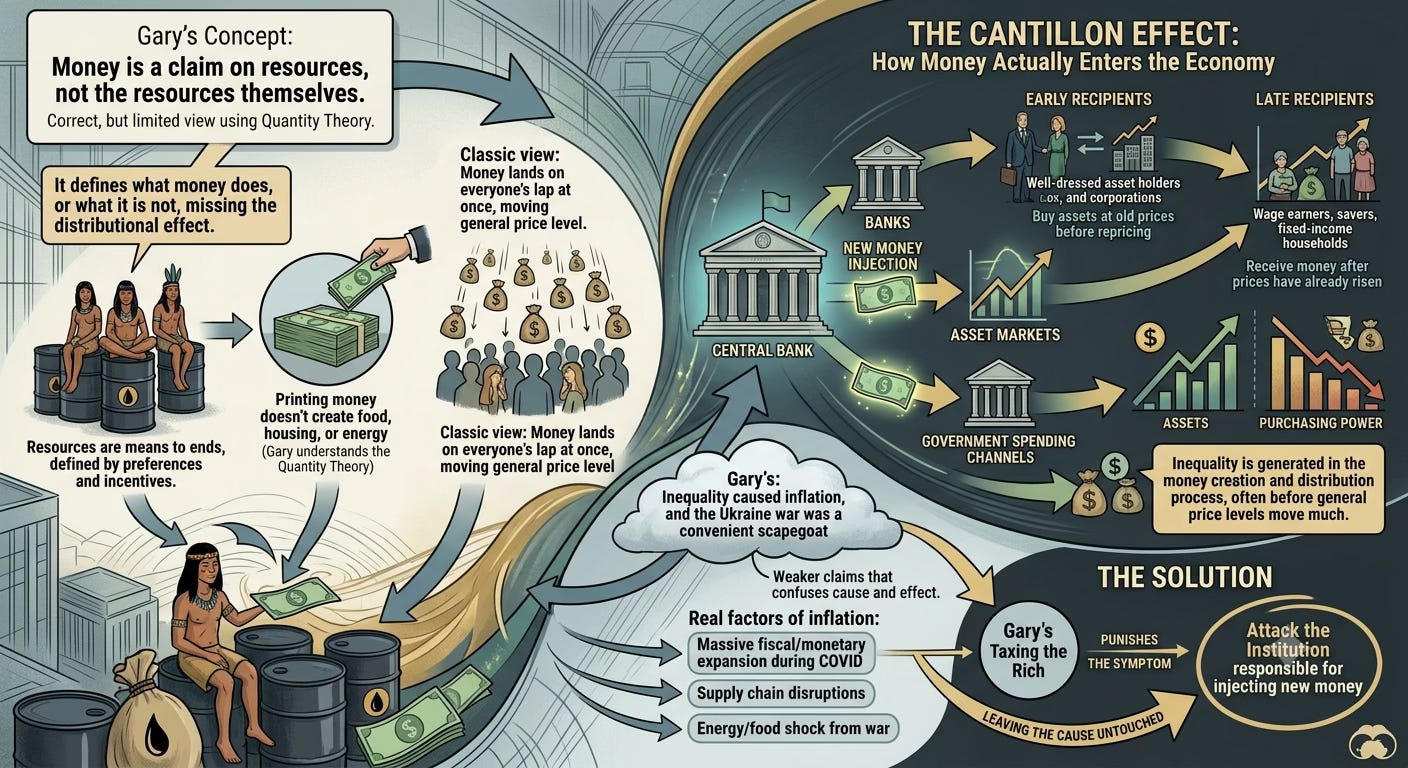
Gary’s definition of money pops up. It is not a clear definition, as I heard in a critique of the definition of money from a gold-banking expert, JamesTurk; it defined what it does, at least kind of. Or it defined money as what it is not. By defining money by what it is not, it clearly outlines two main points that, in economic theory, could be said to be right about how money flows in the economy. This conception at least makes sense from the perspective of the quantity theory of money, although not strictly, as we will see Gary gets the aggregate half of the story right and misses the distributional half entirely.
Firstly, “money is a claim on resources, not the resources themselves.” This is basic and correct. But instead of resources, I would say the know-how of “production” that is only possible through capital; this is where some fellow institutional economists would agree with me. Using an analogy, the Venezuelan indigenous groups sat on per capita 1 million dollars’ worth of non-refined oil since before colonisation. Were they wealthy? You can say that, by modern standards, they were not, but they had more oil resources than all the tycoon groups of aristocrats who dominated european societies at the time. You can say that the conception of wealth at that point in time was different, so it differs from our modern standards, yet this is an anthropological point, and it is important to note that the definition of “wealth” varies across societies. But what counts as a “resource” matters: resources, whether physical assets or money, are only a means to specific ends. These ends are defined by preferences and incentives. Gary says that “printing money doesn’t create food, housing, or energy”. This is a clear example that he understands the quantity theory of money, invoked by the scholastics of the Spanish era and, finally, Milton Friedman.