



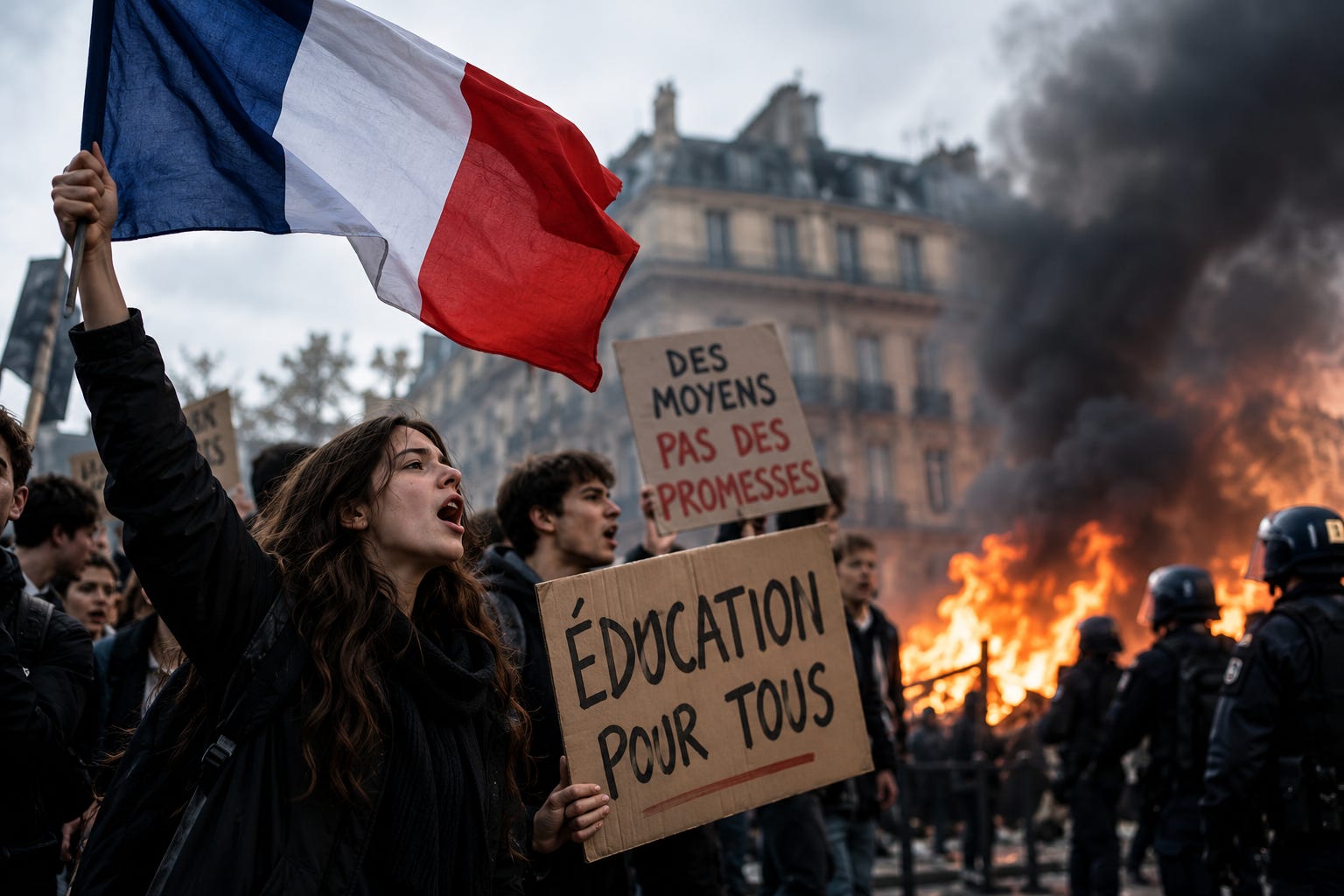
Something is burning in France, but it is not just the barricades outside Parisian high schools. In a matter of weeks, what started as a protest against teacher shortages, overcrowded classes and crumbling school facilities has become a national pitched battle over the future of French public education.
The movement began on September 21 at Saint-Exupéry High School in Créteil, where students joined educators protesting staff shortages and a lack of resources. It spread rapidly throughout the nation. Strikes, demonstrations and blockades affected more than 1,000 schools by early October. At least 1,200 people were arrested amid what the French government called an “escalation in violence”, while an estimated 550,000 people took to the streets in protest. The unrest has caused serious injuries among students. Tear gas has filled streets in Strasbourg, fireworks have been directed at police in Marseille, and protesters have set fire to rubbish bins in Rennes. Authorities say 24 schools have been burned or ransacked. Police have also said they were justified in their actions following reports of serious injuries. A 14-year-old student, Eden, was badly hurt when struck by a tear gas grenade in Saint-Ouen-l’Aumône.
Students have raised concerns about teacher shortages, overcrowded classrooms, long school days, poor facilities and the limited prospects for higher education. In 2013, the number of French secondary school teachers was lower than in 2008, although the total number of pupils was about 250,000 higher. In the public sector, approximately 70 per cent of classrooms have more than 30 students.
The numbers tell another story. In 2024, average spending per secondary school student was €11,660, compared with €11,910 in 2010. The government’s draft 2027 budget calls for a 1.7 per cent rise in education spending to €65.53 billion, excluding teacher pensions. This increase is lower than the rate of expected inflation. At the same time, debt-servicing costs are projected to reach €74.5 billion next year.
For the government, these are questions of fiscal management. For students, however, the consequences are experienced very differently. If a teacher is absent, the class may not take place. When classrooms become overcrowded, teachers have less time to devote to individual students. A failing building becomes an integral part of the school day.
The concept of the “double movement”, coined by Karl Polanyi, is useful here because it describes the disconnect between policy calculations and social reality. The theory explains the tension between market forces and society’s demand for protection. The government has attempted to run education through business-like mechanisms centred on budgets and competition, including the Parcoursup system. This represents the “first movement”. It treats education as a commodity to be allocated rather than a public good to be protected. This has contributed to schools in poor suburbs, known as banlieues, facing shortages of teachers and resources. Education becomes detached from its broader purpose: helping students grow and succeed.
As a result, students and teachers have protested. This is the “countermovement”. However, their demands are not solely about money. They are calling for education to be recognised as a fundamental social right rather than treated as a business. They are attempting to restore education to its place within society. Students have highlighted a double standard: they are expected to perform well without being given the basic conditions necessary to learn. The crisis continues because the government has attempted to address it using the same business-like mechanisms that helped create it, such as offering online surveys in lieu of providing real funding. The state continues to treat education as a market rather than a public service that provides protection and opportunity. This is why the controversy and the crisis remain unresolved.
Education is expected to provide equal opportunities, facilitate social mobility and prepare young people to participate in society. The more we speak of schools in terms of efficiency, budgets, performance and employability, the greater the danger that these broader goals will take a back seat. The countermovement is the students’ response. They are not all calling for an alternative economy, nor do they necessarily share the same political philosophy. Yet, collectively, they are protesting against an institution that is supposed to prepare them for the future but is failing to provide the conditions they need to succeed.
This frustration is compounded by France’s centralised university admissions system, known as Parcoursup. In 2026, around 163,000 applicants reportedly received none of the placements they had requested. From the state’s perspective, such systems can appear administratively rational. From the students’ perspective, however, they can appear to be another mechanism through which an already unequal educational system sorts young people into different futures. This is why the protests go beyond an issue of education spending. They represent a struggle over the social mission of education.
Polanyi’s argument also helps explain why merely restoring order may not be sufficient. The government may dismantle a barricade, close a school for security reasons or arrest a violent protester. However, none of these actions will resolve the teacher shortage. Nor will they fix poorly managed classrooms or address the inequalities affecting students’ learning experiences. The French education crisis has seriously damaged the government’s credibility by exposing a double standard. The state appears weary and ineffective when it comes to equipping educators and improving schools, yet highly effective and assertive when deploying police to break up demonstrations. This dichotomy risks teaching a whole new generation that the state will not be there to help them, but will be quick to intervene when they refuse to obey.
That does not mean violence should be excused. School burnings, assaults on police and damage to public property hurt the very communities that protesters are trying to protect. The state has a legitimate interest in keeping people safe, and those who commit acts of violence should face due process. However, public order and political solutions are not the same thing. Prime Minister Sébastien Lecornu has promised “visible changes” while insisting that there will be “no concessions to violence”. This addresses the immediate crisis, but the government must also respond to the grievances underlying it. Otherwise, the protests may fade without the underlying problems ever being resolved.