

Editor’s Note: This article is a commentary and geopolitical analysis based on current events, policy developments, and market intelligence.
If you value independent, unfiltered analysis on global trade, foreign policy, and macroeconomics, subscribe to The Strategic Desk to get every piece delivered straight to your inbox.
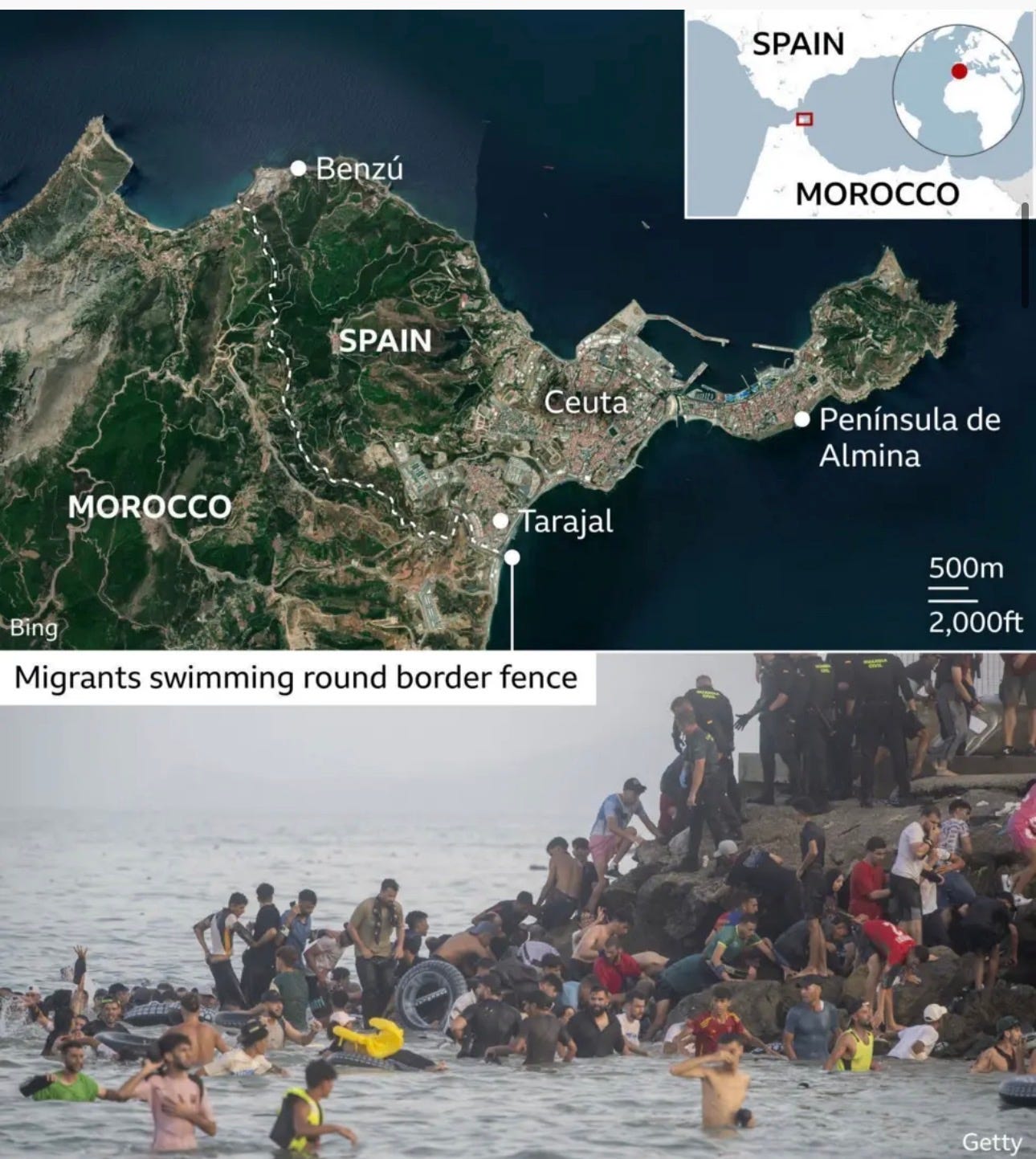
Photo: BBC
On July 29 and 30, 2026, the Spanish enclave of Ceuta in North Africa faced an extraordinary crisis when over 80,000 people crossed into the territory in a matter of hours. While some might hesitate to use strong language, there are few other terms to describe an influx of that scale hitting a tiny enclave. As of today, the immediate situation is largely under control. Spanish military and police forces deployed swiftly, returning an estimated 72,000 people to Morocco. However, between 2,000 and 3,000 migrants—mostly sub-Saharan Africans who cannot easily be deported—remain in the territory, prompting Italy to temporarily suspend the Schengen Agreement to prevent further movement into Europe.
Most commentators blame this event on traditional regional dynamics, noting that relations between Spain and Morocco have deteriorated as Madrid has grown closer to Algeria, Morocco’s bitter rival. The common consensus is that Rabat simply instructed its border guards to stand down in retaliation. That may be true, but it misses the bigger geopolitical picture.
To understand why this happened now, we have to look at Spain’s recent friction with its primary allies. Following the conflict involving Iran and Israel’s offensive in Gaza, Spain has been one of Europe’s strongest critics of Israel, explicitly condemning the actions in Gaza as genocide and officially recognizing a Palestinian state in May 2024. At the same time, Spain remains the only one of NATO’s 32 member states to flatly refuse the new 5% GDP defense spending target pushed by President Trump. Prime Minister Pedro Sánchez labeled the target unreasonable and counterproductive, arguing it is incompatible with maintaining Spain’s robust welfare state, which currently consumes roughly 28% of the country’s GDP.
This raises a fundamental question about collective security. At a time when China is increasing pressure on Taiwan and Russia is actively testing European defense,