


Written by Hayat Nazia
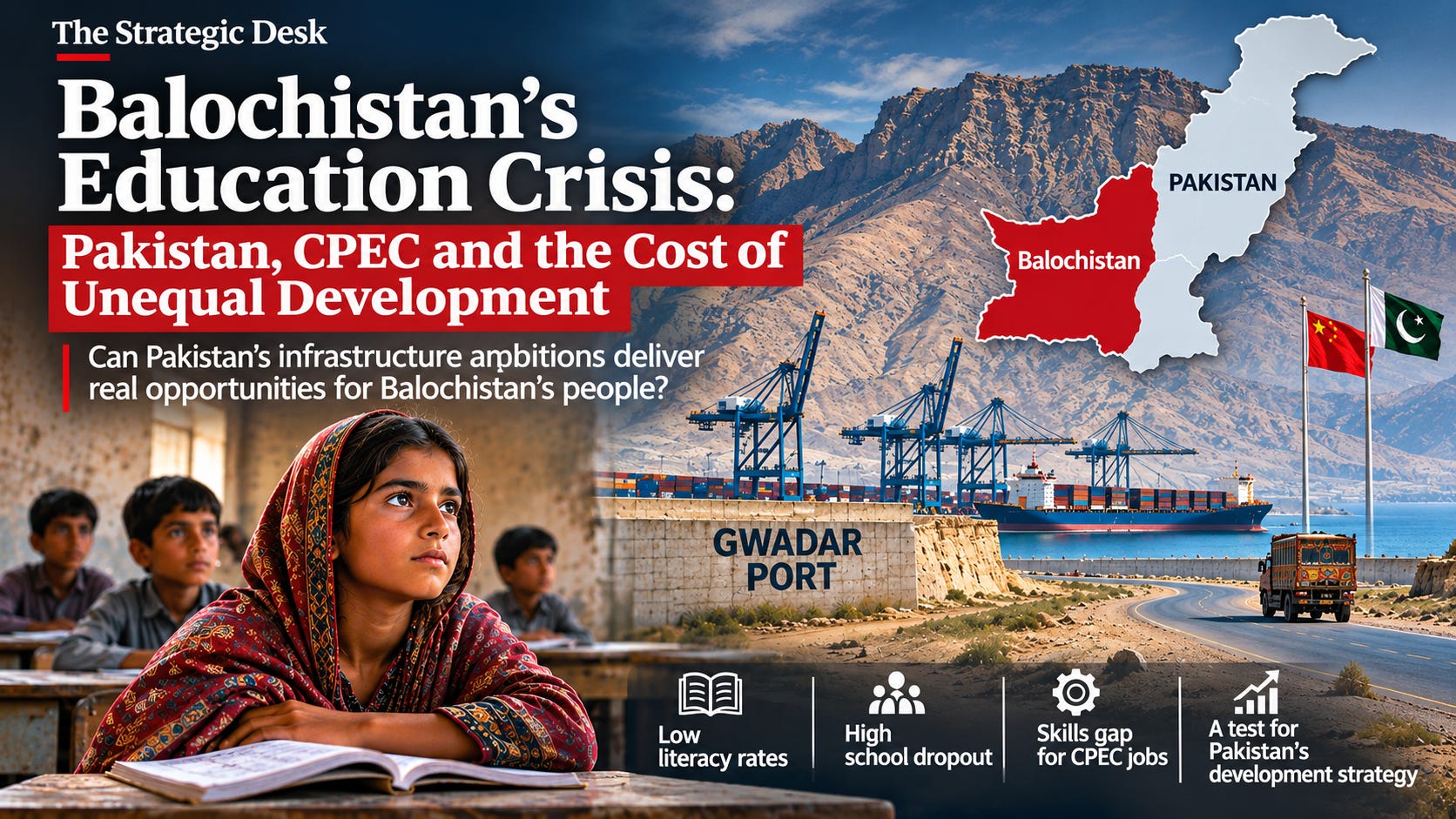
Balochistan’s education crisis is more than a shortage of schools, teachers or public funding. It raises a larger political question: how are public resources allocated, who influences those decisions, and why has infrastructure investment not produced comparable improvements in human development?
The issue also has geopolitical significance. Balochistan shares borders with Afghanistan and Iran and occupies a central position in Pakistan’s regional connectivity ambitions, particularly through the China-Pakistan Economic Corridor (CPEC) and Gwadar Port. These projects are intended to strengthen trade, transport and economic links. However, their long-term value depends partly on whether local communities have the education and skills needed to participate in the opportunities they create.
Infrastructure can connect markets, but an educated and skilled population is needed to make those connections economically productive. Without investment in people, regional development risks leaving local communities behind.
The Scale of the Education Crisis
The Pakistan Bureau of Statistics’ Household Integrated Economic Survey 2024–2025 provides a recent picture of the challenge. Balochistan’s literacy rate among people aged ten and above stands at 49 per cent, compared with 63 per cent nationally. Although the provincial rate has improved from 40 per cent in 2018–2019, Balochistan still has the lowest literacy rate among Pakistan’s provinces.
The survey also reports that 45 per cent of children aged five to sixteen in Balochistan are out of school, compared with 28 per cent nationally. The gender gap is particularly concerning. Approximately 52 per cent of girls are out of school, compared with 38 per cent of boys.
Enrolment also declines as children progress through the education system. The net enrolment rate, which measures the proportion of children enrolled at the appropriate age for a particular education level, stands at 43 per cent at primary level, 25 per cent at middle level and 15 per cent at matric level. These figures highlight the difficulty of retaining children in education beyond primary school (Pakistan Bureau of Statistics, 2025).
Teacher availability presents another challenge. In September 2024, Dawn reported that Balochistan had 48,841 teachers across 15,096 government schools, while approximately 16,000 teaching positions remained vacant. The provincial education department also reported that 3,694 schools were non-functional because of teacher shortages. These figures illustrate how staffing problems can prevent existing infrastructure from delivering education (Shahid, 2024).
The Political Economy of Education
Education policy in Balochistan is shaped not only by available funding but also by the political processes through which development projects are selected and implemented.
In his 2023 study, School Education in Post-18th Amendment Balochistan: A Political Economy Perspective, Rafiullah Kakar examines how political influence and administrative weaknesses affect education planning.
One example concerns development planning in 2018–2019. Kakar reports that approximately 395 education development schemes were sanctioned. According to figures cited in the study, 380 were identified by members of the provincial assembly, while 16 were proposed by the Education Department. These figures total 396 rather than the reported 395, a discrepancy that should be acknowledged.
The wider concern is whether political preferences can take priority over technical assessments of where schools, teachers and educational facilities are most urgently needed. Kakar argues that patronage-based decisions and weak accountability have limited the effectiveness of education reforms (Kakar, 2023).
A 2025 study by Wazir Ali and colleagues also identifies concerns involving unequal resource distribution, nepotism, teacher training and weak monitoring. Based on qualitative research, it provides insight into governance challenges, although its findings should not be treated as a province-wide statistical measurement (Ali et al., 2025).
These issues can also be understood through the work of Karl Marx and Michel Foucault. Marx examined how economic power shapes inequality, while Foucault studied how institutions influence behaviour through rules, routines and systems of observation. Applied to education, their ideas raise important questions about who receives opportunities and how public institutions exercise authority.
CPEC, Gwadar and the Skills Gap
The geopolitical implications become clearer when Balochistan’s education indicators are considered alongside its economic ambitions.
The official CPEC Western Route includes road connections linking Dera Ismail Khan with Zhob, Khuzdar with Quetta and Chaman, and Gwadar with Turbat and Hoshab. These transport links are intended to improve connectivity across areas of strategic and economic importance. Gwadar also has the potential to strengthen Pakistan’s links with regional maritime trade.
However, connectivity alone does not guarantee local economic participation. Port operations, transport networks and industrial development require trained workers, technicians, engineers and professionals with skills in logistics, construction, digital technology and supply chain management.
A 2025 Labour Market Assessment of Balochistan, published by the German development organisation GIZ through its Technical and Vocational Education and Training Sector Support Programme, identifies a substantial gap between the province’s demand for skilled workers and the available supply. It estimates annual demand for 95,465 skilled workers against an available supply of 23,163, leaving a shortfall of approximately 72,300 workers. This represents 75.7 per cent of estimated annual demand.
The assessment identifies particularly high demand in manufacturing, healthcare, renewable energy and construction. It also maps occupational demand in districts including Quetta, Lasbela and Gwadar. The report further notes that 75 per cent of surveyed employers believe vocational training graduates lack practical skills or up-to-date training (GIZ, 2025).
This evidence brings the central problem into focus. Pakistan may expand roads, ports and trade routes, but without a sufficiently skilled local workforce, communities may struggle to access the employment and business opportunities associated with those investments. Employers may need to recruit skilled workers from outside the province, while local people remain concentrated in less specialised work. This is a potential consequence of the skills gap, not evidence that every CPEC project has excluded local workers.
The implications extend beyond employment. If local communities cannot participate meaningfully in development, the economic benefits of regional connectivity may be distributed unevenly. This creates a governance challenge for provincial and federal authorities. Development projects must demonstrate their value not only through completed infrastructure but also through the opportunities they create for the people living in the province.
What Needs to Happen Next?
Pakistan’s regional development strategy needs to connect infrastructure investment with education and workforce development.
First, provincial education spending should be guided by transparent assessments of local needs. Teacher recruitment, postings and transfers must follow merit-based procedures, while school performance should be measured through attendance, learning outcomes and functioning facilities.
Second, technical and vocational training should be linked to actual labour market demand. Training institutions should work with employers to develop courses in construction, renewable energy, manufacturing, logistics, digital technology and other sectors with identified workforce needs. Apprenticeships and workplace training can help students gain practical experience.
Third, girls’ access to education and vocational training must become a central development priority. The gender gap in literacy and school participation restricts the province’s available human resources and limits women’s access to emerging economic opportunities.
The 18th Constitutional Amendment strengthened provincial responsibility for education. Balochistan’s government therefore has a central role in improving service delivery, while federal institutions and CPEC partners can support skills development and stronger links between training institutions and employers.
Conclusion
Balochistan’s education crisis reveals a wider challenge in Pakistan’s political economy and geopolitical strategy. The province has a strategic location and significant infrastructure ambitions, but its ability to benefit from regional connectivity depends on the people who live there.
Recent education and labour market figures demonstrate that the gap between infrastructure ambitions and human development remains substantial. Roads and ports can create economic possibilities, but education and skills determine whether local communities can access them.
For Pakistan, the success of regional connectivity should not be measured only by the movement of goods across borders or the completion of infrastructure projects. It should also be measured by whether people in Balochistan have the education, skills and economic opportunities to participate in the development taking place around them. Without this connection, CPEC may strengthen physical connectivity without delivering its full potential for the province’s economic development.
Can Pakistan achieve its geopolitical ambitions in Balochistan without first investing in its people?
At The Strategic Desk, we examine the political, economic and geopolitical forces shaping our world. Subscribe to The Strategic Desk for independent analysis, research and perspectives that go beyond the headlines.