

Ever since Donald Trump returned to the White House, I have had one question that I keep coming back to:
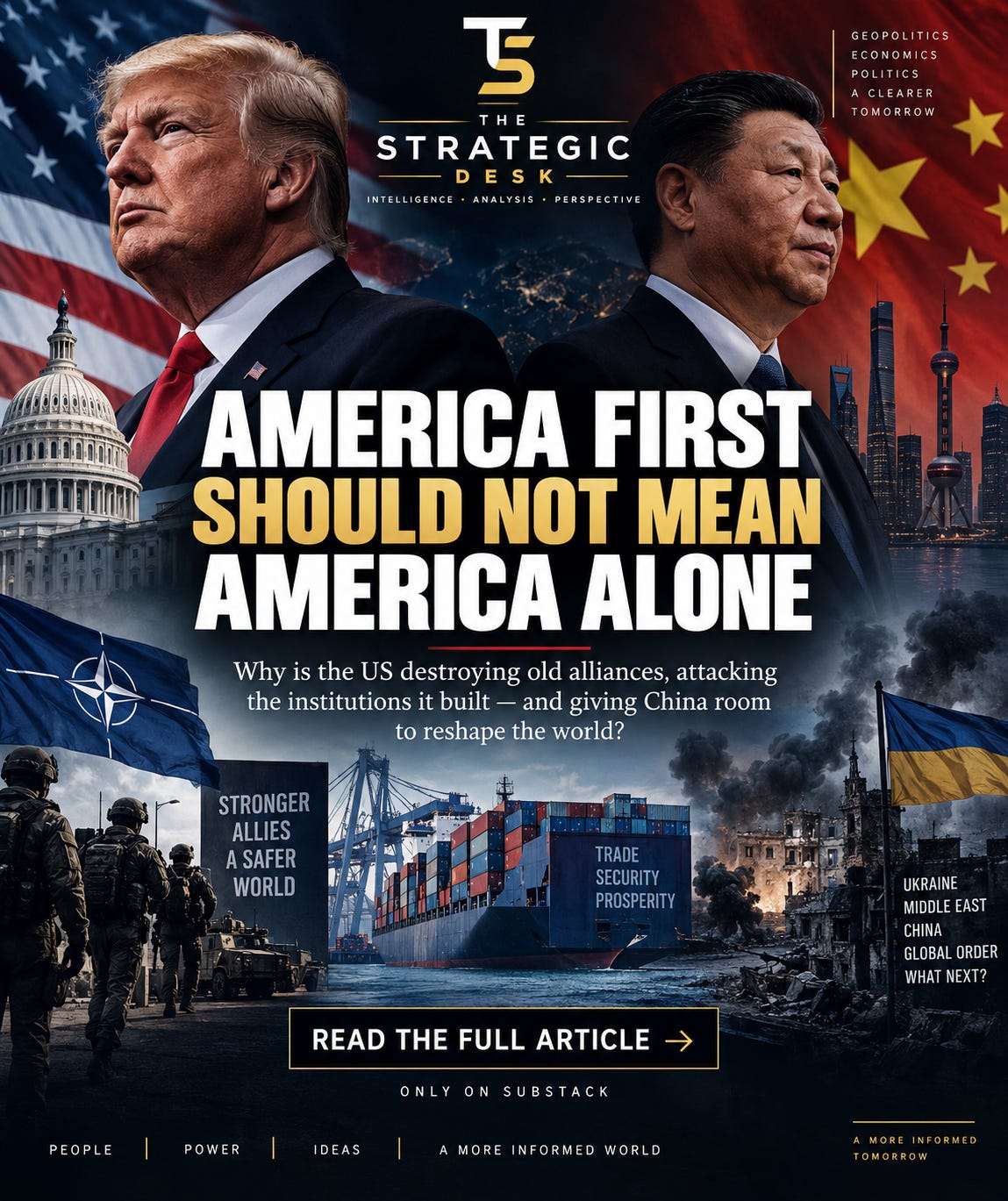
Why is this administration so determined to destroy or weaken some of the alliances and institutions that America itself built, funded or helped create?
Don’t get me wrong. I understand the idea behind America First.
Put American interests first.
Protect American workers.
Get better trade deals.
Make allies contribute more to their own defence.
Stop America from becoming involved in endless wars.
There is nothing inherently wrong with any of that.
In fact, some of those arguments are completely reasonable.
But I did not expect America First to potentially mean America stepping back from the world altogether.
Maybe I was naive.
Because if Washington retreats from its global responsibilities, someone else will eventually fill the space.
And that someone is likely to be China.
America built the system. Why destroy it?
This is where I struggle with the current direction of American foreign policy.
For decades, the United States helped build the international system that exists today.
America helped create the institutions, alliances and economic relationships that allowed Western countries to become incredibly prosperous and secure.
NATO.
The post-war trading system.
The global financial system.
International institutions.
Security partnerships across Europe and Asia.
America didn’t simply participate in this system.
America was one of its architects.
And yes, America paid a huge price for being the leader of it.
Washington has spent decades funding its military, protecting shipping routes, maintaining alliances and responding to crises around the world.
So I understand why many Americans are asking:
“Why are we paying for everyone else?”
That’s a legitimate question.
But there is another question Americans should ask:
“What happens if we stop?”
Because leadership has a cost.
So does the absence of leadership.
America First — yes. America alone — no.
I support the basic principle that American foreign policy should serve American interests.
But America First should not mean America alone.
There is a difference.
America can demand that NATO members spend more on defence.
America can demand better trade agreements.
America can negotiate harder with allies.
America can reduce unnecessary military commitments.
America can tell Europe that it needs to take more responsibility for European security.
None of that requires Washington to destroy the alliances that give America global influence in the first place.
This is the part I think Washington needs to be careful about.
An alliance is not charity.
NATO isn’t simply America doing Europe a favour.
It is also an enormous American strategic advantage.
America gets military bases, intelligence cooperation, diplomatic influence and a network of allies across the world.
The same applies to America’s relationships in Asia.
Alliances create something China does not currently possess at the same scale:
a global network of partners.
Why would Washington voluntarily weaken one of its greatest strategic advantages?
The tariff problem
One of my biggest disagreements with the Trump administration has been the decision to pursue broad tariffs across the global economy, including against American allies.
I understand the argument.
America has run large trade deficits for decades.
Manufacturing has moved overseas.
China has built an export-driven economic model that has created enormous trade surpluses.
Washington has every right to ask whether the existing trading system is fair.
But I think there is a much better target:
China.
If Washington believes China’s economic model is undermining American industry, then American policy should be heavily focused on Beijing.
Instead, applying tariffs broadly to allies risks creating a completely different problem.
Trust.
Because what message does it send to America’s allies?
You stood with America for decades.
You bought American weapons.
You shared intelligence.
You fought alongside American soldiers.
You supported Washington during major international crises.
And now you are being treated as a trade adversary?
I think that’s a mistake.
Tariffs can be removed.
But credibility is harder to rebuild.
Who actually benefits?
This is the question I keep asking whenever I look at American foreign policy.
Who benefits from this?
If America weakens its relationship with Europe, who benefits?
China.
If America creates uncertainty among its Asian allies, who benefits?
China.
If America weakens confidence in the Western economic system, who benefits?
China and, to some extent, Russia.
This is why I think Washington needs to think beyond individual trade deals.
The United States isn’t operating in a vacuum.
It is competing with countries that are actively trying to increase their influence.
China is not simply trying to participate in the international system.
Beijing increasingly wants to reshape the balance of power within it.
That is a completely different strategic challenge.
Washington finally realised something about China
There was once a strong belief in Washington that integrating China into the global economy would eventually encourage political liberalisation.
The theory was relatively straightforward:
More trade.
More wealth.
More contact with the West.
More economic freedom.
Eventually, perhaps, more political freedom.
That did not happen.
Instead, the Chinese Communist Party has remained firmly in control, while China’s economic and technological power has grown enormously.
The pandemic also exposed another problem.
Dependency.
America discovered that relying heavily on China for certain critical goods and supply chains could create serious vulnerabilities.
Pharmaceuticals.
Critical minerals.
Technology.
Manufacturing.
Strategic supply chains.
This has changed the way Washington thinks about economics.
Economic security is now national security.
That is one area where I think the Trump administration deserves credit.
The United States has become much more willing to confront China’s unfair trade practices and the vulnerabilities created by excessive economic dependence.
But confronting China requires strategy.
It doesn’t require Washington to alienate everyone else.
The allies America should be strengthening
I understand Trump’s frustration with NATO.
There are countries that have not spent enough on defence.
There are governments that have relied heavily on American military power.
America cannot realistically be expected to defend every country in the world while everyone else simply sends the bill to Washington.
That isn’t sustainable.
But there is a difference between telling your allies:
“You need to do more.”
And telling them:
“You are part of the problem.”
The first creates stronger alliances.
The second can destroy them.
America needs Europe.
Europe needs America.
Japan needs America.
South Korea needs America.
Australia needs America.
And increasingly, countries across Asia need American power as a counterweight to China.
These relationships are not weaknesses.
They are American power.
The Middle East problem
Then there is the Middle East.
Trump came back to Washington promising an end to America’s endless wars.
That message resonated with a lot of Americans.
And I understand why.
America has spent enormous amounts of blood and money fighting wars in the Middle East without always achieving the political outcomes it wanted.
But this creates another contradiction.
You cannot campaign against endless wars and then become involved in another major conflict without answering a very simple question:
What is the endgame?
How does the war end?
What does victory look like?
What happens the day after?
And how does America leave without creating an even bigger regional crisis?
These are not small questions.
They are the questions that determine whether military intervention is a strategy or simply another commitment that becomes increasingly difficult to escape.
And if America’s stated goal is to avoid endless wars, then Washington needs to explain exactly how it intends to get out.
Ukraine is another test of American leadership
Then there is Ukraine.
I actually think there is a reasonable argument for making European countries carry more of the financial burden of supporting Ukraine.
America cannot be expected to fund European security indefinitely.
And there is a perfectly legitimate argument for Europe purchasing more American weapons rather than Washington simply giving military equipment away.
That creates an economic relationship while strengthening Ukraine’s ability to defend itself.
But I think America also needs to be clear about something:
Russia’s invasion of Ukraine was an act of aggression.
American leadership does not necessarily mean sending American soldiers into every conflict.
It can mean diplomacy.
It can mean weapons.
It can mean sanctions.
It can mean intelligence.
It can mean economic pressure.
It can mean organising allies.
Leadership doesn’t always require American troops.
But it does require American credibility.
And then there is China
This is ultimately where I think Washington should be looking.
Beijing.
China is the long-term strategic challenge.
Not because China is automatically going to replace America.
I don’t believe that.
America remains extraordinarily powerful.
Its economy is enormous.
Its military remains unmatched in many areas.
Its universities, technology companies, financial markets and global alliances give it enormous advantages.
China has serious weaknesses of its own.
But Beijing is clearly trying to increase its influence.
And if America voluntarily retreats from parts of the world, China will not simply sit there and wait.
It will move into the space.
That’s how geopolitics works.
Power hates a vacuum.
I don’t want a Chinese-led world order
This is perhaps the most important part of my argument.
I don’t think the world is ready for a Chinese-led international order.
And I don’t think it would be desirable.
China is not a liberal democracy.
Political opposition is heavily restricted.
Criticism of the Communist Party can carry serious consequences.
The state plays an enormous role in the economy.
Businesses operate within a political system where the government ultimately holds enormous power.
That is not the model of political freedom that the West has spent decades defending.
And this isn’t about saying China is evil.
It is about recognising that different political systems produce different international orders.
If Beijing eventually becomes the dominant global power, the rules of the international system could change.
That doesn’t necessarily mean China will conquer countries.
It doesn’t need to.
Influence can be created through trade.
Technology.
Infrastructure.
Investment.
Diplomacy.
Military power.
Supply chains.
Financial relationships.
And political partnerships.
China doesn’t need to become the next America.
It simply needs to become powerful enough that the rest of the world starts operating according to Chinese preferences.
The biggest danger isn’t American decline
And this brings me back to my original question.
Is America actually declining?
I don’t think that’s the right question.
The United States is still an extraordinarily powerful country.
The bigger question is:
What will America do with that power?
America can remain the leading power while asking allies to contribute more.
It can negotiate tougher trade agreements.
It can confront China.
It can protect American workers.
It can reduce unnecessary wars.
It can put American interests first.
But it should not confuse leadership with weakness.
America doesn’t need to control everything.
It doesn’t need to police every country.
It doesn’t need to fight every war.
But it does need to recognise that the international system it helped build provides America with enormous strategic advantages.
Destroying that system without a credible alternative could create a gift for America’s biggest competitor.
America First, but not America alone
This is where I land.
America First? Absolutely.
American interests should come first in American foreign policy.
But America alone? Absolutely not.
The United States has spent decades building alliances, institutions and economic relationships that have helped make it the most influential country in the world.
Washington should reform that system where necessary.
It should demand more from allies.
It should confront unfair trade.
It should reduce unnecessary military commitments.
It should make China the central long-term strategic priority.
But it should not destroy the very system that gives it influence.
Because China is challenging the existing world order.
And I worry that America is doing something even more dangerous:
America is dismantling parts of the world order it created.
And if Washington keeps moving in that direction, the biggest geopolitical change may not be the decline of American power.
It may be something more profound.
The end of the assumption that America will always use its power to maintain the international order it helped create.
And if that happens, we should not assume that the world that replaces it will be better.
The world needs American leadership.
Not American domination.
Not endless wars.
Not America paying for everyone.
But leadership.
Because America First should never have to mean America alone.
Enjoying The Strategic Desk?
Subscribe to continue reading and get more geopolitical analysis, political commentary and research delivered directly to you.
The world is changing. We explain why.